
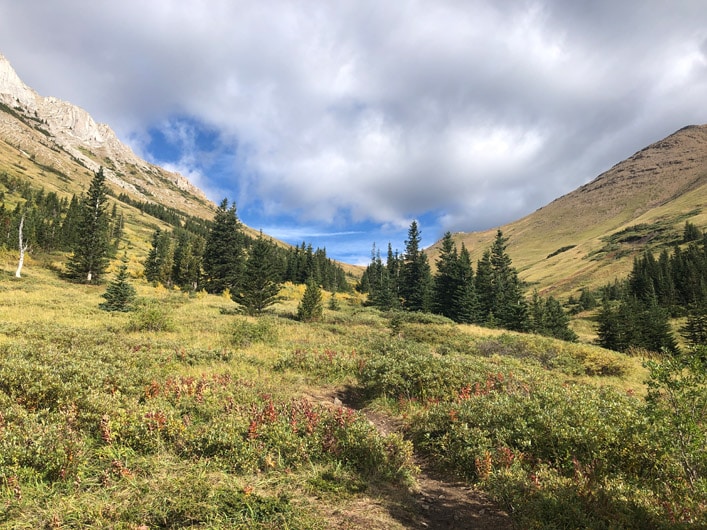
For most of September, the larches do not look particularly special.
They are green, they blend into the forest, and unless you know what you are looking at, you might walk straight past them.
Then the nights get colder.
Almost overnight, entire mountain valleys start turning gold.
Larch season around Calgary is short enough that people plan weekends around it. Trailhead parking lots fill before breakfast. Hikers who normally avoid early mornings suddenly leave the city in the dark.
And then, just as quickly as the colour arrives, the needles fall.
If you want to see golden larches near Calgary, you need to head west into Kananaskis or Banff. You do not need to climb a mountain, though. Some of the easiest places to see them require little more than a short walk.
Here are the places I would look at first, starting with the easiest.
When do the larches turn yellow near Calgary?
The best colour usually arrives during the second half of September.
Some years peak colour comes a little earlier. Other years it hangs around into October.
Weather decides.
Cold nights speed things up. Strong wind can strip the needles surprisingly quickly once they are ready to fall. An early mountain snowstorm can also change trail conditions in a matter of hours.
Tourism Canmore Kananaskis says the golden colour normally lasts only a few weeks, with some larches hanging on through the first week or two of October.
If I were planning specifically for larches and had complete flexibility, I would aim for roughly the third and fourth weeks of September.
If you are reading this in early October, do not automatically assume you missed them.
Check recent trail photos and go.
You might still catch that perfect combination of golden trees and the first snow on the mountains.
Wait, what exactly is a larch?
Larches confuse people because they look like evergreen trees for most of the year.
They are not.
They are deciduous conifers.
They grow needles like spruce and fir trees, but those needles change colour in autumn and eventually fall off.
That is what creates the bright yellow and gold forests you see in September photographs from the Canadian Rockies.
The larches people drive from Calgary to see are generally found at higher elevations.
That is why driving around Calgary looking for random yellow trees is not quite the same thing.
For the full effect, you need to get into the mountains.
Mount Lorette Ponds is the easiest option
If you want fall colour without really going hiking, start here.
Mount Lorette Ponds sits off Highway 40 in Kananaskis and has a short paved loop around the water.
The entire walk is around one kilometre.
There are picnic tables.
There are mountain views.
And scattered larches can reflect beautifully in the ponds when the water is calm.
Tourism Canmore Kananaskis describes Mount Lorette Ponds as an accessible option with moderate larch viewing rather than one of the huge alpine displays.
That distinction is worth understanding.
You are not walking through a massive golden forest.
You are getting an easy taste of larch season in a beautiful setting.
For someone travelling with young children, older relatives, or anyone who does not want a proper hike, that is a pretty good trade.
Highwood Meadows gets you into the larches with almost no effort
Highwood Pass is one of the best places near Calgary during larch season because the road does most of the climbing for you.
By the time you park, you are already high in the mountains.
Highwood Meadows has a short accessible route of roughly 1.2 kilometres return, with larches growing around the high elevation landscape. Tourism Canmore Kananaskis calls it one of the easiest ways to stand among subalpine larches.
This is probably where I would take someone who wants the classic golden larch experience but cannot manage a longer mountain hike.
There is one problem.
Everybody else has the same idea.
The Highwood Pass area becomes extremely busy during peak larch weekends.
Do not expect to casually arrive around noon on a sunny Saturday and find an empty parking lot waiting for you.
Go early.
Or go later in the afternoon with enough daylight remaining.
And never invent your own parking space on the side of the highway because the proper lot is full.
Ptarmigan Cirque gives you the biggest reward for a short hike
If you are willing to actually hike, Ptarmigan Cirque may offer the best ratio of effort to scenery on this list.
The loop is roughly 4.5 kilometres with around 210 metres of elevation gain according to Tourism Canmore Kananaskis.
The beginning climbs more steeply than the distance might make you expect.
Then you reach the cirque.
The landscape opens.
Mountains surround you.
And during the right week in September, golden larches are scattered across the alpine terrain.
It looks like you completed a much bigger hike than you actually did.
That makes Ptarmigan Cirque extremely popular.
It is not a secret local alternative to Larch Valley.
Come during peak colour on a beautiful weekend and expect company.
Still, if somebody asked me for one relatively short larch hike near Calgary, this would be high on the list.
Arethusa Cirque is close by and a little rougher
Arethusa Cirque sits in the same general Highwood Pass area.
The route is also relatively short, at roughly 4.5 to 5 kilometres, but it is more demanding than the numbers initially suggest.
Tourism Canmore Kananaskis lists around 324 metres of elevation gain and rates the route as moderate.
You climb through beautiful fall colour toward a rocky alpine bowl beneath Arethusa Mountain.
The trail feels less polished than Ptarmigan Cirque in places.
That is part of the appeal.
It also means I would not automatically choose Arethusa for somebody who simply wants an easy walk among yellow trees.
Choose it because you want the hike too.
During larch season, the small roadside parking area can become one of the more frustrating parts of the trip.
An early start helps.
Chester Lake is the classic Kananaskis larch hike
If you have seen photographs of a turquoise lake surrounded by yellow larches beneath grey mountain walls, there is a decent chance you were looking at Chester Lake.
This is one of those hikes that becomes a completely different place for a few weeks every fall.
The summer route is about 9.2 kilometres return with roughly 300 metres of elevation gain.
The first section climbs through forest.
Eventually the trail opens into alpine meadows.
That is when the larches start stealing the show.
Keep going and you reach Chester Lake beneath the surrounding mountains.
When the larches are gold and the water is calm enough for reflections, it is easy to understand why the trail gets so much attention.
The downside is obvious.
It gets busy.
Very busy.
I would much rather hike Chester Lake on a weekday during larch season than battle the weekend rush.
If a weekday is impossible, leave Calgary early.
Really early.
Not Calgary weekend early.
Larch season early.
Rummel Lake gets slightly less attention
Rummel Lake is one of my favourite alternatives to consider when Chester Lake seems like the obvious choice.
It is not empty.
Nothing this pretty is going to be empty during peak larch season.
But Chester gets more name recognition.
Rummel Lake is roughly 10 kilometres return with about 420 metres of elevation gain.
The trail climbs through forest before reaching more open mountain terrain and eventually the lake.
In autumn, golden larches around the lake make the final destination much better.
There is also something satisfying about seeing yellow larches reflected in water rather than simply walking past individual trees.
If you want a moderate half day hike and have already done Chester, I would look at Rummel.
Rawson Lake is beautiful even if larches are not the whole story
Rawson Lake is another popular autumn option in Peter Lougheed Provincial Park.
The hike is around 7.8 kilometres return.
You begin around Upper Kananaskis Lake, walk along the shoreline, then climb through the forest toward Rawson Lake.
The lake sits beneath a dramatic mountain wall, and larches add colour around the basin in fall.
Tourism Canmore Kananaskis rates the larch display as moderate to good rather than exceptional.
That is exactly how I would think about it.
Do not choose Rawson because you want the densest possible golden forest.
Choose it because Rawson Lake is already a worthwhile destination and larch season makes it better.
It is also important to check current wildlife advisories before leaving Calgary.
This area is prime grizzly habitat and closures do happen.
Burstall Pass is where I would go for a longer day
If the short trails sound too easy and you actually want to spend most of the day hiking, Burstall Pass deserves a look.
The route is roughly 15 to 16 kilometres return, depending on exactly where you turn around, with about 470 metres of elevation gain. Tourism Canmore Kananaskis rates the larch display as excellent.
The longer distance naturally spreads hikers out more than a short trail like Ptarmigan Cirque.
That does not mean you will have the mountains to yourself.
It means everybody is not standing in the same small viewpoint area at the same time.
The payoff is a broader alpine landscape filled with fall colour.
This is the option I would choose when larches are part of the reason for hiking but I still want a proper full day in the mountains.
Larch Valley is famous for a reason
Now we leave Kananaskis and head into Banff National Park.
Larch Valley above Moraine Lake is probably the most famous larch hike in Alberta.
Normally, a place this popular starts making me suspicious.
Larch Valley earns the attention.
You start at Moraine Lake and climb into a forest that becomes increasingly golden as you gain elevation.
Eventually the trail opens into Larch Valley beneath the Valley of the Ten Peaks.
Parks Canada lists the trail to Larch Valley and Minnestimma Lakes at 4.5 kilometres each way, with 570 metres of elevation gain. Allow roughly three and a half to four hours for the return hike.
This is not the easiest hike on the list.
It is also nowhere near the easiest logistically.
You cannot drive your car to Moraine Lake
This changes how you need to plan Larch Valley.
Moraine Lake Road is closed to personal vehicles year round.
For the 2026 season, Parks Canada shuttles to Moraine Lake operate through October 12, weather permitting. Reservations are required for Parks Canada shuttle service.
If you show up in Lake Louise during larch season without transportation arranged, there is a very real chance you will not get to Moraine Lake at all.
Book first.
Then plan the hike.
As of early October 2026, Parks Canada still lists Larch Valley as open with wet and muddy sections, while noting snow at higher elevations in the Lake Louise area.
That is a good reminder that golden larch season and early winter can overlap.
Sometimes beautifully.
Sometimes inconveniently.
Is Larch Valley worth the extra hassle?
For a first larch hike in the Canadian Rockies, yes.
I would do it at least once.
You get Moraine Lake and Larch Valley in the same day, which is a pretty difficult combination to beat.
But if you live in Calgary, I would not automatically drive to Banff every September just because Larch Valley is famous.
Kananaskis has outstanding larch hiking without needing a Moraine Lake shuttle reservation.
That convenience matters when the weather forecast suddenly looks perfect and you decide to go hiking tomorrow.
What about Pocaterra Ridge?
Normally, Pocaterra belongs near the top of any list of larch hikes near Calgary.
The lower valley can become an enormous field of gold.
The ridge above it gives you one of the best elevated views of the larch forest anywhere in Kananaskis.
Access in this area has been complicated by construction work and closures in recent seasons.
By late September 2026, hikers were again reporting access to the new Pocaterra Cirque route and the ridge, but this is exactly the kind of place where I would check the latest Alberta Parks advisory immediately before leaving.
Do not rely on an article written months earlier for a trail that has recently been affected by construction.
If everything is open and conditions are good, Pocaterra deserves consideration.
If access is uncertain, you already have plenty of excellent alternatives.
Where should you go if you do not want to hike?
Mount Lorette Ponds.
That is the easiest answer.
Highwood Meadows is another excellent choice when accessible and parking is available.
Neither gives you the same overwhelming golden forest experience as walking into Larch Valley or Chester Lake.
But you can enjoy fall colour without climbing hundreds of metres.
That matters if you are travelling with parents, small children, someone recovering from an injury, or simply somebody who thinks spending six hours hiking sounds terrible.
You do not have to earn every mountain view through suffering.
Where should you go for a short hike?
Ptarmigan Cirque.
It is hard to beat.
You get high alpine scenery, lots of larch colour and a manageable distance.
Arethusa Cirque is a good alternative when you want something a little more rugged.
Where should you go for a half day hike?
Chester Lake or Rummel Lake.
Chester would be my first choice for the classic autumn lake scene.
Rummel would be my choice when I want something slightly less obvious.
Rawson Lake also fits nicely into this category, especially if the lake itself interests you as much as the larches.
Where should you go for a full day?
Burstall Pass if you want a longer Kananaskis hike.
Larch Valley if you want the famous Banff experience and can arrange Moraine Lake transportation.
Pocaterra Ridge is another excellent full day choice when current access and trail conditions allow.
Do you need a Kananaskis Conservation Pass?
Yes for the Kananaskis locations in this article when you park a vehicle in the pass area.
The current personal vehicle price is $15 for a day pass or $90 for an annual pass. The annual pass can register up to three vehicles.
Buy it before heading into the mountains.
Mobile service can be unreliable exactly when you suddenly remember you still need a pass.
Parking during larch season is ridiculous
There is no elegant way to say this.
The popular parking lots can be a mess.
Larch season combines three things that create crowds.
The scenery is unusually good.
The window is very short.
Everybody knows approximately when it will happen.
That concentrates a huge number of hikers into only a few weekends.
My favourite solution is a weekday.
If you can take a random Tuesday off in late September, this is an excellent use of it.
If weekends are your only option, leave early.
Do not assume that driving from Calgary at 9 will somehow beat the crowd.
By then, plenty of people are already hiking.
Please do not park like an idiot
A full parking lot is not permission to block the highway, create a dangerous blind corner, drive onto fragile vegetation, or prevent emergency vehicles from getting through.
Some larch trailheads have limited parking because they were never designed for the number of people who now arrive during peak weekends.
If there is nowhere legal and safe to leave the vehicle, choose another hike.
There are worse things than missing one trail.
Creating a traffic hazard to photograph yellow trees is one of them.
What time should you leave Calgary?
For a popular weekend hike, I would rather leave too early than too late.
The exact time depends on the trail.
Highwood Pass is a longer drive from Calgary than Mount Lorette Ponds.
Chester Lake requires travelling the Smith Dorrien road.
Larch Valley requires an entirely different shuttle schedule.
As a general rule, if I am planning one of the famous Kananaskis larch hikes on a September weekend, I want to be at the trailhead in the morning rather than still drinking coffee in Calgary.
The exception is a deliberate late afternoon visit to an easy location.
That can work beautifully when the morning crowd begins leaving and there is still enough daylight.
Just remember how quickly days get shorter in fall.
What should you wear?
Prepare for autumn and winter on the same hike.
This is the Rockies.
September can produce warm sunshine, rain, wind, freezing temperatures and snow.
Sometimes all in one weekend.
Bring a warm layer.
Bring a shell.
Bring gloves.
A toque weighs almost nothing.
If snow or overnight freezing has created icy sections, microspikes can make a huge difference.
As of October 3, 2026, Parks Canada is already reporting icy sections on some higher Lake Louise area trails.
Do not look at the Calgary weather forecast and assume that is what you will experience several thousand feet higher in the mountains.
Bring bear spray
Larch season is still bear season.
You are walking through active wildlife habitat at a time of year when bears are trying to consume a lot of calories before winter.
Carry bear spray.
Know how to use it.
Keep it accessible.
Make noise in areas with limited visibility.
Pay attention to wildlife closures.
Alberta Parks recommends carrying bear spray and travelling with awareness in Kananaskis backcountry areas.
The number of cars at the trailhead does not turn the mountains into a city park.
My favourite strategy for larch season
I would not obsess over finding the single best larch hike.
The difference between a great day and a frustrating one often has more to do with timing than the trail name.
A famous hike under grey skies with an overflowing parking lot can be less enjoyable than a supposedly second tier option on a quiet weekday morning.
Watch the weather.
Watch recent trail reports.
Pick your difficulty.
Then go where the logistics make sense.
If I wanted the easiest outing, I would choose Mount Lorette Ponds or Highwood Meadows.
If I wanted maximum scenery for a relatively short hike, I would choose Ptarmigan Cirque.
If I wanted the classic Kananaskis lake hike, I would choose Chester Lake.
If I wanted a longer day, I would choose Burstall Pass.
And if I had never experienced Larch Valley above Moraine Lake, I would deal with the shuttle logistics and do it once.
The important part is not spending three weeks trying to decide.
Larch season is too short for that.
One windy night can take a mountain full of gold and leave half the needles on the ground.
Pick a trail.
Check the conditions.
And go.
Did you know that your internet service provider can track your online activity? Want to hide your identity online and keep your browsing habits private? Try NordVPN!
*This post might contain affiliate links. If you click on a link, I might receive a small commission.
