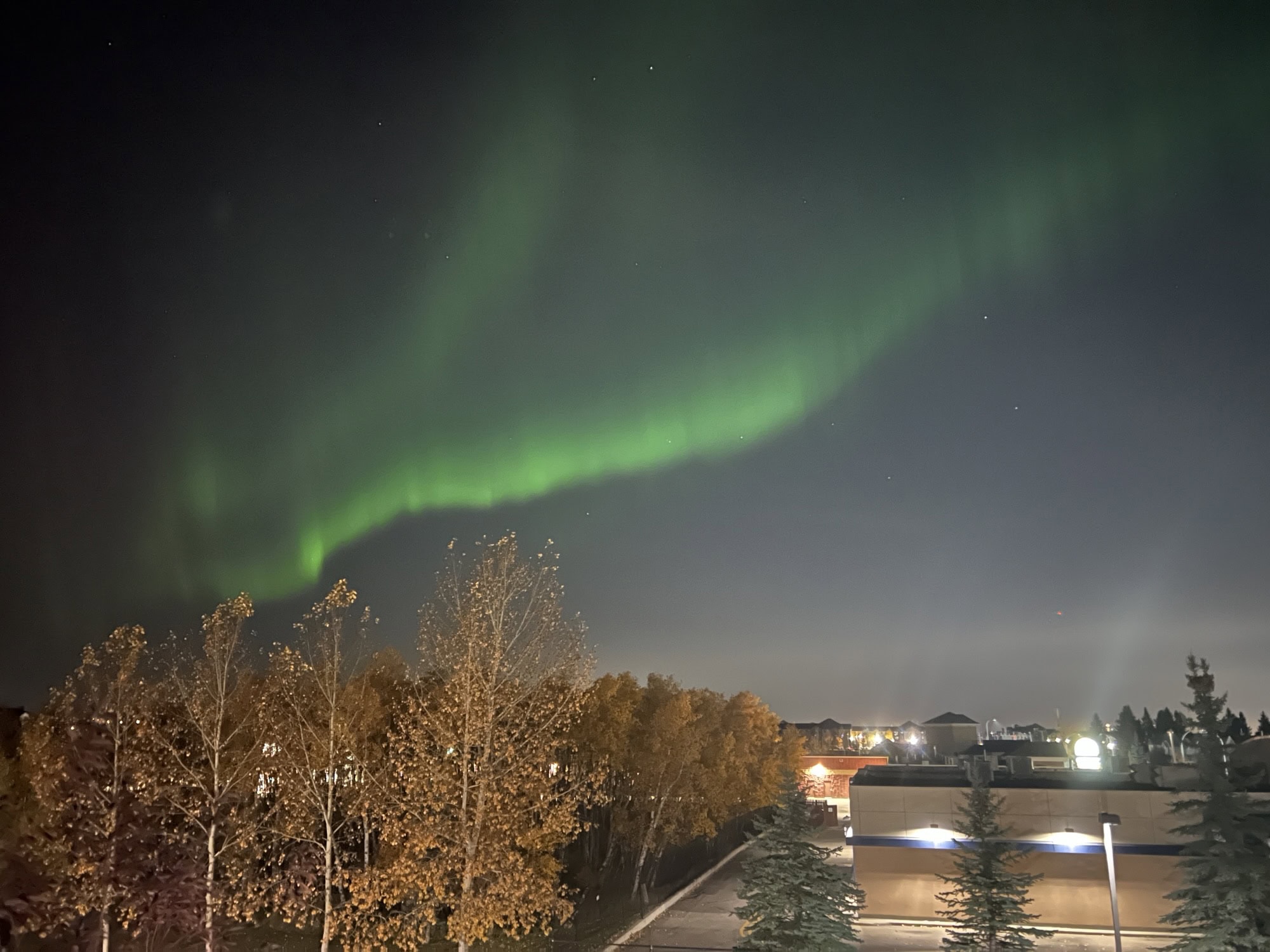
Every time there is a decent aurora forecast around Calgary, the same question shows up almost immediately.
Where should I go?
Then somebody says drive north.
Somebody else says drive west.
Another person says they saw the northern lights perfectly from their backyard in Tuscany.
Meanwhile half of Calgary is already in the car heading somewhere dark.
The good news is that you do not need to drive three hours into the wilderness to see the northern lights from Calgary.
On a strong night, you can sometimes see them right inside the city.
On weaker nights, getting away from Calgary’s light pollution can make an enormous difference.
The trick is knowing where to go, what direction to look and whether tonight is actually worth leaving the house for.
Yes, you can see northern lights from Calgary
Calgary is far enough north that the aurora occasionally becomes visible directly from the city.
During stronger geomagnetic storms, people have photographed bright displays from neighbourhoods all over Calgary.
That happened several times in 2025 and 2026.
During a strong display in July 2026, Calgary residents shared photographs from inside the city, while another major display in November 2025 was visible from neighbourhoods including Sage Hill, Brentwood and areas close to downtown.
So before jumping into the car, go outside.
Seriously.
Turn off the backyard lights.
Give your eyes a few minutes to adjust.
Look north.
If the aurora forecast is particularly strong, look overhead too.
Sometimes everyone is driving away from Calgary while the lights are already dancing above their house.
Why leaving Calgary still helps
City lights wash out faint aurora.
The northern lights might technically be above Calgary while appearing to your eyes as little more than a pale grey haze.
Drive into darker countryside and suddenly that same haze becomes easier to see.
The stars become brighter too.
Travel Alberta recommends getting away from urban light pollution whenever possible and specifically notes that rural locations improve your chances of seeing the aurora.
You do not necessarily need complete wilderness.
Even getting beyond the edge of Calgary can make a noticeable difference.
The most important thing is finding somewhere dark with a clear view toward the north.
Nose Hill is the easiest place to try inside Calgary
If the aurora forecast looks strong and I did not want to leave the city, Nose Hill would be one of the first places I would consider.
It is elevated.
Large parts of the park are relatively dark compared with surrounding neighbourhoods.
There are wide views across the sky.
Most importantly, you can look north without standing between downtown office towers.
Nose Hill covers more than 11 square kilometres, so there is plenty of open space. The City of Calgary currently lists park hours from 5 in the morning until 11 at night.
That last part matters.
Do not arrive at midnight expecting to stay all night.
Calgary parks normally close at 11 at night unless otherwise posted. Vehicles left inside locked parking areas can remain trapped until the following morning.
For an early evening aurora display, Nose Hill can be excellent.
For something expected around 1 in the morning, you need another plan.
The northwest edge of Calgary can work surprisingly well
You do not always need a designated aurora viewing destination.
The outer northwest communities naturally have less city light to their north than neighbourhoods closer to downtown.
That is why people regularly report seeing the aurora from places such as Sage Hill, Tuscany and Rocky Ridge during stronger displays. Recent Calgary discussions include people seeing northern lights from northwest communities without leaving the city.
If you live in that part of Calgary, check your own neighbourhood before driving anywhere.
Find the darkest safe place you can legally access.
Look toward the northern horizon.
Give your eyes time.
You may already have a perfectly good viewing spot ten minutes from home.
Ghost Lake is one of the easiest darker options west of Calgary
If I wanted to leave the city but did not want a huge drive, Ghost Lake would be high on my list.
You get darker skies, plenty of open space and broad horizons.
Travel Alberta specifically includes Ghost Lake among the Alberta locations where getting away from city lights can improve your chance of seeing the northern lights.
The drive from Calgary is also reasonable enough for a spontaneous night trip.
That matters with aurora chasing.
Forecasts change.
Clouds move.
Sometimes you have only a few hours between deciding the conditions look promising and actually seeing something.
Driving somewhere like Jasper every time an aurora alert appears would get old very quickly.
Ghost Lake is much more realistic.
Just remember that darkness does not mean you can park anywhere you want.
Use legal parking areas.
Do not stop on the highway.
Do not block gates or private property.
And slow down. Wildlife is harder to see at night.
The foothills southwest of Calgary have genuinely dark skies
The countryside toward Priddis and southwest of Calgary gets much darker than the city.
There is a reason the University of Calgary operates the Rothney Astrophysical Observatory in this area.
The observatory is about 20 kilometres southwest of Calgary and conducts research on dark skies and light pollution.
That does not mean you should type Rothney Observatory into your navigation app every time the aurora forecast turns red.
Do not do that.
The observatory is only open to the public during scheduled events, and the University of Calgary specifically warns visitors not to arrive without a ticket or park along the highway.
The useful information here is the location.
The foothills southwest of Calgary can offer much darker skies than the city.
If you know a legal public place in the area with safe parking and an open northern view, conditions can be excellent.
Do not trespass onto private land.
Do not pull onto somebody’s driveway.
Darkness does not make private property public.
North and northeast of Calgary can be even better
People automatically associate aurora chasing with driving toward the mountains.
That is not always the best idea.
Remember what you are trying to see.
The northern sky.
Drive south of Calgary and the city’s glow may now sit directly between you and the northern horizon.
Drive north or northeast and Calgary is behind you.
The prairie also gives you something mountains do not.
A huge open horizon.
That can be particularly useful when the aurora is sitting relatively low in the northern sky.
Calgary aurora discussions repeatedly recommend getting north of the city or finding darker prairie skies when conditions are not strong enough to overcome urban light pollution.
You do not need one famous parking lot.
You need darkness, legal access and a clear horizon.
That is often easier to find on the prairie than beside a famous attraction.
Do not randomly stop on rural highways
This deserves its own section because aurora chasing makes otherwise sensible people do strange things.
A beautiful green sky appears.
Everybody panics.
Cars start pulling onto shoulders.
People stand beside dark highways wearing black jackets.
Please do not become part of that scene.
Find a proper parking area.
Pull completely off the road.
Keep headlights pointed away from other people whenever practical.
Watch for traffic.
Watch for wildlife.
And never stand in an active roadway because your phone needs a slightly better composition.
The aurora has been happening for a very long time.
It will survive without that photograph.
You can also stay in Calgary if you do not have a car
One of the most common questions in Calgary travel groups is where to see the aurora without driving.
That is harder, but not hopeless.
During strong displays, city light pollution matters much less.
People have reported seeing aurora from central and suburban Calgary during major storms.
Your best strategy is to get away from bright commercial areas and find the darkest legal public space available before park closing time.
Nose Hill is an obvious choice.
Some people also head toward Fish Creek Park or the outer edges of the city, although Calgary park hours still apply.
If the display is strong enough, your own backyard might beat spending an hour crossing the city.
When is the best time of year for northern lights in Calgary?
You can see aurora at any time of year.
That July 2026 display over Calgary proves the point nicely.
The problem with summer is darkness.
Calgary evenings stay bright for a very long time around June and July.
The aurora may be active while the sky is simply too bright to appreciate it properly.
From fall through early spring, nights are longer.
Travel Alberta recommends October through March as especially good months for aurora watching in Alberta.
September and October can be particularly pleasant because you get genuinely dark nights without standing outside at minus 25.
There is nothing wrong with winter aurora chasing.
It just requires better boots.
What time do northern lights appear?
This is the question everybody wants a simple answer to.
There is not one.
The aurora does not begin every night at 10 and finish at midnight.
A display can strengthen, fade and return several times throughout the night.
Sometimes the best activity happens before bedtime.
Sometimes people give up at midnight and the sky explodes an hour later.
That unpredictability is part of the game.
Instead of asking what time northern lights normally appear, watch current geomagnetic activity and local reports.
If people north of Calgary suddenly start posting photographs, that is considerably more useful than a generic statement saying the aurora might be visible sometime tonight.
Stop obsessing over the Kp number
You will see people treating the Kp index like an aurora traffic light.
Kp 3 means stay home.
Kp 6 means drive immediately.
Reality is messier.
Kp describes planetary geomagnetic activity. It can be useful as a quick reference, but it does not guarantee what you will see over Calgary at a particular minute.
Natural Resources Canada publishes Canadian geomagnetic conditions and forecasts broken into polar, auroral and sub auroral zones. Its short term forecast updates throughout the day.
That is worth checking because it gives you Canadian space weather information rather than relying entirely on a single number inside an app.
Use Kp as one clue.
Not as a promise.
Cloud cover matters more than people think
You can have an incredible aurora storm happening above Alberta and see absolutely nothing.
Why?
Clouds.
The northern lights occur far above ordinary weather.
Clouds sit between you and the aurora.
No amount of geomagnetic activity makes clouds transparent.
This is why I check the ordinary weather forecast at the same time as the aurora forecast.
If Calgary is completely overcast but skies are clear an hour east, driving east might make much more sense than driving north.
Sometimes the correct aurora destination is simply wherever the clouds are not.
Smoke can ruin the view too
This has become an increasingly important summer consideration in Alberta.
Wildfire smoke can reduce visibility even when the sky technically looks clear enough on a weather app.
A strong aurora may still cut through light haze.
A faint display may disappear completely.
If smoke is heavy, save yourself the drive.
There will be other nights.
You need actual darkness
This sounds obvious until you arrive somewhere that looked remote on a map and discover a gas station, subdivision or industrial site lighting the entire northern horizon.
Darkness matters most when the aurora is faint.
Turn off unnecessary lights once parked.
Give your eyes about 15 to 20 minutes to adjust.
Avoid staring at a bright phone screen every 30 seconds.
If you need a flashlight, use a dim setting or red light.
The Rothney Observatory recommends red light because it helps preserve night vision.
You will start noticing much more detail in the sky once your eyes adjust.
Your phone may see the aurora before you do
This surprises first timers.
You arrive at a dark location.
Everybody online is posting bright green photographs.
You look north and see something that resembles a grey cloud.
Open your phone camera.
Suddenly it is green.
Modern phone cameras are much more sensitive to faint colour than our eyes under dark conditions.
Calgary aurora watchers frequently report exactly this experience, with displays appearing much stronger through a phone camera than to the naked eye.
That does not mean every grey cloud is secretly the northern lights.
Stars are the giveaway.
If you can see stars through the strange pale shape, there is a good chance you are looking at aurora.
Clouds hide stars.
Aurora does not.
How to photograph northern lights with a phone
You do not need an expensive camera anymore.
Most newer phones can produce surprisingly good aurora photographs.
Start with night mode.
Hold the phone as still as possible.
A small tripod helps enormously.
If the aurora is faint, allow the phone to use a longer exposure.
If the aurora is bright and moving quickly, shorter exposures can preserve more detail instead of turning everything into a green blur.
Turn off the flash.
The flash will illuminate whatever unfortunate person is standing five feet in front of you.
It will not illuminate the upper atmosphere.
Also lower your screen brightness.
Your eyes will thank you.
Why the aurora sometimes looks grey instead of green
This is one of the biggest expectation problems created by social media.
Cameras collect light differently from our eyes.
A faint aurora that photographs as vivid green may look pale or almost colourless in person.
During stronger displays, the colour becomes obvious.
Green is usually easiest to see.
Strong storms can produce visible reds, pinks and purples as well.
So if your first aurora looks like a suspiciously moving grey ribbon, do not assume you failed.
Watch it.
Give your eyes time.
Take a photograph.
Sometimes the display strengthens dramatically within minutes.
What direction should you look?
Start north.
That is the obvious answer for a reason.
When aurora activity is moderate around Calgary, it often first appears relatively low toward the northern horizon.
As activity strengthens, the display can climb higher into the sky.
During major storms it can appear directly overhead or even extend toward the southern sky.
If everybody is staring north while a huge auroral corona develops above them, somebody eventually notices.
Then the entire parking lot turns around at once.
Do mountains make northern lights better?
They make photographs better.
That is different.
A mountain reflected in a lake beneath a green sky is obviously more dramatic than the same aurora above a field.
But mountains can block part of your northern horizon.
If the aurora is weak and sitting low, a beautiful mountain location can actually make it harder to see.
Prairie viewpoints are underrated for exactly this reason.
Nothing is blocking the horizon.
If the goal is simply seeing the aurora, open sky beats Instagram scenery.
Is Banff a good place for northern lights?
It can be.
Banff has darker skies than Calgary and ridiculous scenery when the aurora cooperates.
But I would not automatically drive to Banff every time an aurora alert appears.
That is a lot of driving for a phenomenon that may disappear before you arrive.
Calgary also sits east of the mountains with broad access to darker prairie and foothills skies.
If the forecast is strong, I would first look for somewhere much closer.
Save Banff aurora chasing for nights when you are already staying there or when photography is the whole point of the trip.
Is Kananaskis good for northern lights?
Yes, with the same caveat.
Darkness is excellent.
Mountain scenery is excellent.
Your northern horizon may not be.
Think about the exact geography of your viewing location.
Also remember that driving mountain roads late at night adds wildlife, weather and road conditions to the equation.
A dark field 40 minutes from Calgary may produce a better evening than a famous lake reached after two hours of driving.
What about the Rothney Observatory?
Go when there is a public event.
Do not use it as an unofficial aurora parking lot.
The Rothney Astrophysical Observatory is a working University of Calgary research facility and is only open to the public during scheduled programs and ticketed events.
Its location does tell you something useful, though.
The foothills around Priddis have dark enough skies for a professional observatory.
If you want to learn more about astronomy rather than simply chase the aurora, one of the observatory’s public Space Nights is worth watching for.
The moon is not as important as clouds
People sometimes abandon a promising aurora night because the moon is bright.
A full moon can wash out a weak display and make astrophotography more difficult.
But a strong aurora can still look fantastic with moonlight.
Cloud cover is a much bigger deal.
I would rather have a strong aurora under a bright moon and clear sky than a new moon behind solid clouds.
If everything else is equal, darker moon conditions help.
They are not a requirement.
How long should you wait?
This is the painful part.
There is no correct answer.
I have seen people give up after an hour of nothing, drive home and then discover social media full of photographs taken 20 minutes later.
That is aurora chasing.
If forecasts remain promising and the sky is clear, I would give it time.
Bring coffee.
Bring snacks.
Dress much warmer than you think you need to.
Standing still beside a car at midnight feels much colder than walking around Calgary at the same temperature.
If activity appears to be weakening everywhere and you are tired, go home.
There will be another night.
Dress like it is colder than the forecast
You are not hiking.
That makes the cold worse.
You might stand in one place for an hour staring at the sky.
In October, that can become uncomfortable quickly.
In January, it can become miserable.
Bring gloves.
Wear warm boots.
Bring another jacket.
Keep a blanket in the vehicle.
A thermos of something hot is never a bad idea.
Travel Alberta specifically recommends warm clothing, food, water and a warm drink when heading out to watch the night sky.
Nobody has ever complained that their aurora chasing car contained too much hot chocolate.
My simple aurora checklist
I would not leave Calgary until I checked four things.
First, is geomagnetic activity actually elevated?
Second, is the sky clear where I plan to go?
Third, can I reach a dark location with a clear northern horizon?
Fourth, do people nearby seem to be seeing anything yet?
That final one is where social media becomes genuinely useful.
Local aurora groups can tell you what is happening right now.
Someone north of Calgary posting a photograph taken two minutes ago is extremely useful information.
Someone sharing a news article saying northern lights may be visible sometime tonight is much less useful.
Where I would go from Calgary
For a strong display, I would first walk outside.
If I could already see it, I would probably save myself the drive.
If city lights were washing it out and the show looked promising, I would choose based on where I lived.
From northwest Calgary, I would head beyond the city toward darker open skies.
From central Calgary, Ghost Lake is a reasonable option when I want a known destination rather than random rural roads.
From the southwest, I would look toward darker foothills country while being careful not to treat the Rothney Observatory itself as a public viewing site.
If I had no car and the display was happening before 11 at night, I would try Nose Hill.
And if clouds covered half the region, I would forget all of those plans and drive toward the clear sky.
That is really the secret.
The best northern lights spot near Calgary changes every night.
Sometimes it is a dark lake.
Sometimes it is a prairie road.
Sometimes it is Nose Hill.
And once in a while, after everybody spends an hour discussing where to drive, the best view turns out to be from the backyard.
