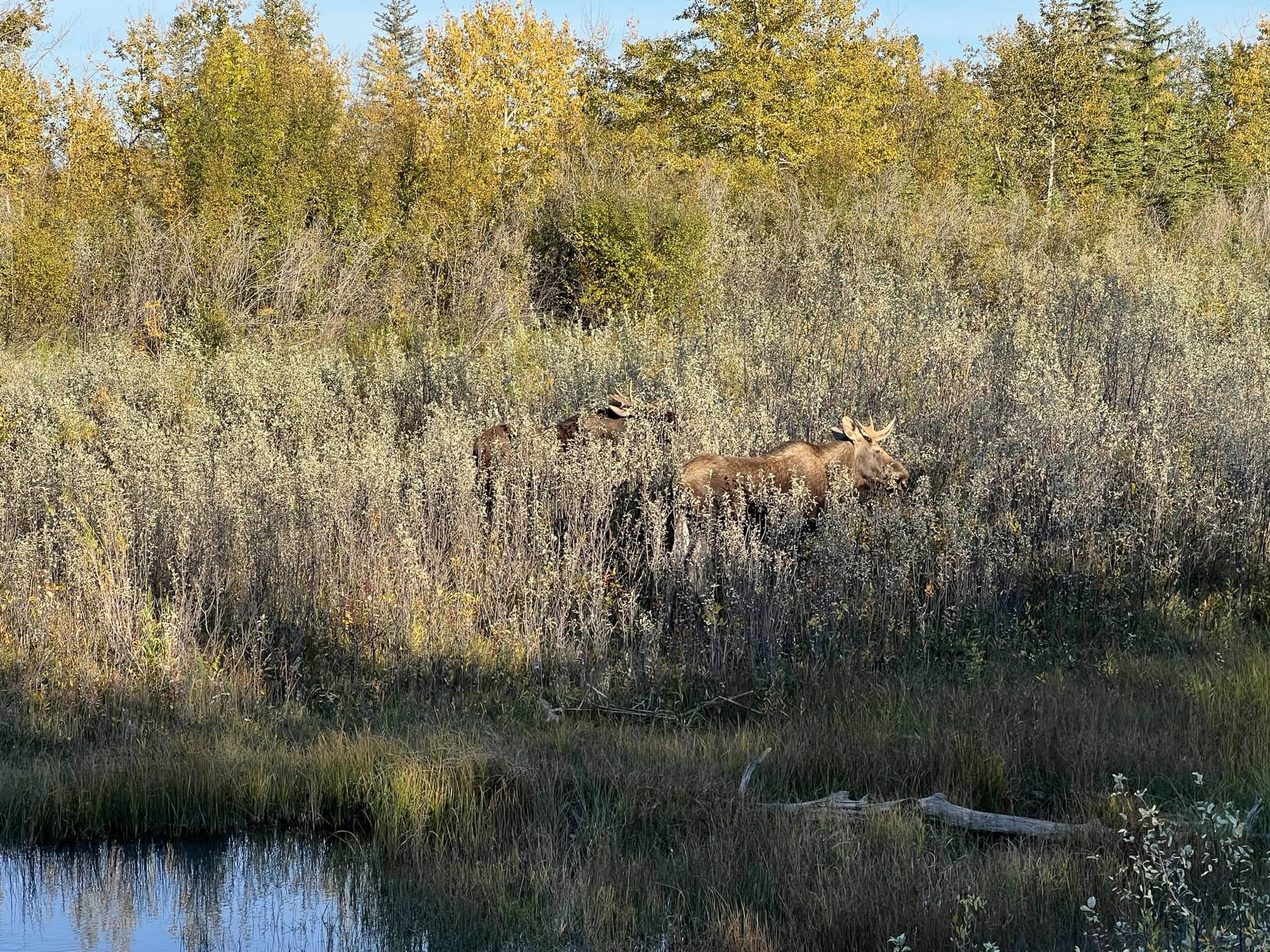
There’s something unforgettable about seeing a moose in the wild.
Maybe it’s the enormous size.
Maybe it’s the long legs that somehow make the animal look awkward and powerful at the same time.
Or maybe it’s simply the surprise of turning a corner on a quiet trail and realizing there’s an animal larger than a horse standing beside the trees.
Whatever the reason, seeing a moose is one of those Alberta wildlife experiences people remember.
And the good news is that you don’t necessarily need to drive deep into the Rocky Mountains to find one.
Moose live in natural areas around Calgary, and they occasionally wander into parks and residential neighbourhoods within the city itself.
But spotting one isn’t as simple as visiting a particular trail and expecting an animal to appear.
Moose are wild, solitary animals that move according to food availability, weather and seasonal conditions.
You could visit the same park ten times without seeing one.
Then encounter a moose during an ordinary morning walk when you weren’t expecting anything unusual.
So where are the best places to look for moose near Calgary?
And when are you most likely to see one?
Here’s what you should know before heading out.
Are there actually moose in Calgary?
Yes.
Moose are native to Alberta and can occasionally be found within Calgary’s natural park system.
The city has extensive river valleys, wetlands, forests and green spaces that provide suitable habitat.
Moose sometimes travel through these areas while searching for food or moving between habitats.
They may also wander into residential neighbourhoods.
The Government of Alberta explains that expanding communities and urban parks have increased the opportunities for moose and people to encounter each other.
That’s why occasional moose sightings happen in places that might seem surprising.
You don’t necessarily need to be standing in the wilderness.
A moose could appear near a park pathway, alongside a road or in a residential area close to natural habitat.
But urban moose sightings are unpredictable.
And because these are large wild animals, they should never be treated as a tourist attraction that people can approach.
If you want to see moose near Calgary, the best approach is to enjoy natural areas where suitable habitat exists and consider a sighting a bonus.
1. Griffith Woods Park is one of the best places to look inside Calgary
If I were choosing a Calgary park specifically because it provides moose habitat, Griffith Woods would be near the top of my list.
Located in the southwest community of Discovery Ridge, Griffith Woods is a beautiful natural environment park along the Elbow River.
It’s very different from an ordinary city park.
There are mature white spruce trees, wetlands, ponds and quiet forest trails.
In some sections, the surroundings feel much more like a natural woodland than a landscaped urban recreation area.
That makes it appealing for wildlife watching.
And there’s a good reason to include it on this list.
The City of Calgary specifically identifies moose among the wildlife species that use Griffith Woods.
The park also supports deer, birds and other animals.
Where should you walk in Griffith Woods?
Start with the designated public pathways and explore the natural forest areas.
The park contains both paved and unpaved routes.
Much of the terrain is relatively flat, making it suitable for a relaxed walk.
I would pay particular attention to the surrounding habitat rather than trying to reach one specific viewpoint.
Moose often use areas near wetlands and vegetation where they can browse for food.
But don’t leave the designated trails or enter sensitive areas trying to locate one.
Griffith Woods is protected natural habitat.
Several informal trails near the Tsuut’ina Nation boundary have also been permanently closed to protect the area and prevent trespassing.
Respect the signs and fences.
The park is located near 45 Discovery Ridge Link SW.
You can learn more on the City of Calgary’s Griffith Woods page.
2. Weaselhead Flats offers excellent wildlife habitat
Weaselhead Flats is another place worth exploring if you’re hoping to see wildlife without leaving Calgary.
Located at the western edge of the Glenmore Reservoir, the park contains wetlands, forests, meadows and sections of the Elbow River delta.
It’s one of the most interesting natural environments within the city.
The mixture of water, trees and open spaces provides habitat for a wide variety of animals.
Deer, beavers, coyotes and numerous bird species can be found in the area.
Moose are also occasional visitors.
That’s an important distinction.
Weaselhead Flats is suitable moose habitat, but it isn’t a guaranteed viewing location.
You might see a moose.
Or you might spend the entire morning watching birds and exploring the forest.
Fortunately, the park is beautiful even when the largest animal you encounter is a squirrel.
Where is the best entrance?
A commonly used entrance is near 37 Street SW and 66 Avenue SW.
From there, public pathways lead toward the natural areas near the reservoir and river.
There are additional access points connected to the surrounding pathway network.
Use designated routes and pay attention to seasonal conditions.
Some trails can become muddy or icy, depending on the weather.
The park is also a sensitive natural environment, so dogs should remain leashed where required.
You can find official park information through the City of Calgary’s Weaselhead Flats page.
3. Fish Creek Provincial Park is worth exploring
Fish Creek Provincial Park is one of Calgary’s largest and most popular natural areas.
The park stretches across much of southern Calgary and includes forests, grasslands, wetlands and river environments.
It’s an excellent place for walking, cycling, birdwatching and spending time outdoors.
Wildlife is part of the experience.
Deer and coyotes are more commonly encountered than moose, but occasional moose movement through the area’s natural habitat is possible.
I wouldn’t consider Fish Creek a reliable place to see a moose on demand.
However, if you’re hoping to combine a pleasant walk with the possibility of encountering wildlife, it’s worth visiting.
Where should you look in Fish Creek?
Instead of focusing on the busiest picnic areas, consider designated trails near natural vegetation and water.
Moose are associated with wetland habitats, forest edges and areas with suitable shrubs.
But don’t enter closed areas or leave trails to search for animals.
The goal should be observing wildlife naturally.
Not chasing it.
And because Fish Creek is such a large park, you can enjoy many different landscapes during one visit.
Even if you don’t see a moose, you may encounter deer, birds or signs of other wildlife.
For park maps and regulations, visit Alberta Parks.
4. West Bragg Creek is another area worth considering
If you want to get farther from Calgary without driving all the way to Banff, West Bragg Creek is a good option.
The area is located west of Bragg Creek, roughly an hour from Calgary depending on your starting point.
It contains forests, wetlands, creek valleys and an extensive trail network.
These landscapes can provide habitat for moose and other large mammals.
But again, sightings aren’t guaranteed.
Many visitors come to West Bragg Creek for hiking, cycling, cross country skiing or snowshoeing.
Wildlife watching is an additional reason to appreciate the surroundings.
What time should you visit?
Early morning can be appealing because wildlife may be more active and human activity is often lower.
However, don’t assume every quiet trail will produce a moose sighting.
And remember that West Bragg Creek is an active recreation area.
During winter, certain trails are groomed or designated for skiing.
Follow the posted trail rules so you don’t damage groomed tracks or interfere with other users.
If you’re unfamiliar with the area, start on an established route suitable for your experience.
Moose aren’t the only large animals that may use these forests.
Be aware of your surroundings and carry appropriate wildlife safety equipment.
5. Kananaskis Country offers a better wilderness experience
If you’re willing to travel farther from Calgary, Kananaskis Country is one of the most appealing regions for wildlife watching.
The area contains enormous stretches of forest, mountain valleys, wetlands and protected wilderness.
Moose live in suitable habitats throughout the region.
But Kananaskis is a very large place.
You can’t simply enter Kananaskis Country into your navigation app and expect to arrive at a moose viewing location.
The landscape includes numerous valleys, roads and provincial parks.
Some provide suitable moose habitat.
Others are much less likely to offer sightings.
And animals move continuously.
I would focus on accessible public areas where you can enjoy the landscape while keeping an eye out for wildlife.
What about the Kananaskis Valley?
The Kananaskis Valley is a reasonable place to begin.
It has forested mountain scenery, waterways and public recreation areas.
You can enjoy a scenic drive and explore suitable public trails when conditions permit.
The area around Peter Lougheed Provincial Park also contains extensive wildlife habitat.
However, these are not guaranteed places to see moose.
And you should never leave marked trails or enter restricted wildlife habitat simply because you hope to find one.
Moose are particularly associated with wet areas and vegetation such as willow shrubs.
But that doesn’t mean you should approach every wetland or wander into marshy areas.
Wildlife viewing is best done from established trails, viewpoints and legal roadside pullouts.
You can find maps and access information through Alberta Parks Kananaskis Country.
Is Moose Mountain near Calgary a good place to see moose?
Here’s something that can confuse people.
Moose Mountain is a well known destination southwest of Calgary, near Bragg Creek.
And naturally, the name sounds promising.
But don’t assume that a place called Moose Mountain guarantees moose sightings.
The mountain is popular for outdoor recreation, and the surrounding region contains wildlife habitat.
However, moose sightings depend on where animals are moving and whether suitable habitat is nearby.
You don’t need to climb Moose Mountain to improve your chances.
In fact, moose are often more associated with lower elevation wetlands, forest edges and areas with shrubs than exposed mountain summits.
If your goal is wildlife watching rather than hiking, I’d prioritize appropriate habitat and established public trails.
Don’t let the mountain’s name make the decision for you.
What is the best time of year to see moose near Calgary?
Moose can be seen throughout the year.
But their behaviour and visibility change with the seasons.
Some periods may offer more opportunities to observe them in suitable habitat.
Others require additional caution.
Spring
Spring can be an interesting time for wildlife watching as animals become more active around available vegetation.
But it’s also a sensitive period.
Female moose may give birth to calves during late spring.
A mother with a young calf can be extremely protective.
Never approach a calf, even if it appears to be alone.
The mother may be nearby.
And getting between a female moose and her calf can be very dangerous.
If you encounter a young moose, leave the area calmly and give it plenty of space.
Summer
During warmer months, moose often spend time near wetlands, water and vegetation.
They may use shaded areas and cooler habitats during hot weather.
Early morning and evening can be good periods for general wildlife activity.
But summer also brings more people into parks.
Popular trails can become busy.
And that human activity may reduce your chances of observing animals in certain locations.
If you’re looking for a peaceful walk, visiting early can be enjoyable whether you see a moose or not.
Fall
Fall is a particularly interesting period because it includes the moose mating season.
The rut generally occurs from late September into October.
Bull moose may become more active while searching for females.
They can also become more aggressive.
This is not the time to approach a moose for a better photograph.
Even an animal that appears calm may react suddenly.
Give moose substantial space and remain especially cautious during the rut.
Winter
Winter can also offer opportunities to see moose near Calgary.
The Government of Alberta notes that moose sometimes use urban park pathways, roads and alleys during winter because packed surfaces can make travelling easier.
They may also move through residential neighbourhoods near natural habitat.
In some situations, moose are attracted to road salt or deicing material.
This is one reason drivers should remain alert, especially near parks and forested roads.
Winter sightings can be memorable.
But never assume a moose on a pathway will move away simply because you’re approaching.
Give it space and choose another route if necessary.
What time of day are moose most active?
Moose are often more active around dawn and dusk.
These periods can provide good opportunities for wildlife observation.
The Government of Alberta specifically warns drivers to be alert near sunrise and sunset because moose activity can increase around those times.
However, animals can appear at any hour.
A moose may be feeding during the morning, resting in vegetation during the afternoon or crossing a road in the evening.
There isn’t a guaranteed viewing window.
For photography, early morning has an additional advantage.
The light is often softer, and natural areas may be quieter.
But if you’re planning to explore a remote park around dawn, remember that visibility may be limited.
Wildlife safety is more important than arriving at exactly the right moment.
How can you tell if a moose is nearby?
You might notice animal tracks, browsing marks on shrubs or other signs of wildlife activity.
Moose have large hooves and can leave distinctive tracks in snow, mud or soft ground.
They also feed on shrubs and woody vegetation.
During winter, you may notice branches that have been browsed.
However, identifying tracks and feeding signs isn’t always straightforward.
Other animals can leave similar evidence.
And the presence of tracks doesn’t mean the animal is still nearby.
I wouldn’t recommend following tracks into forests or off public trails.
Doing so can disturb wildlife and potentially lead to an unexpected close encounter.
It’s much better to remain on designated routes and observe the surrounding landscape quietly.
If a moose happens to appear at a safe distance, enjoy the experience.
If not, you’ve still had a walk through a beautiful natural area.
How close can you get to a moose?
Not very close.
And this is important because moose can look surprisingly calm.
An animal might be standing quietly beside a trail, chewing on vegetation.
That doesn’t mean it’s comfortable having people nearby.
Moose are enormous and capable of moving quickly.
A startled or defensive moose can seriously injure a person.
Alberta’s wildlife viewing guidance recommends staying at least 30 metres from most wildlife and increasing your distance whenever an animal appears uncomfortable.
With moose, giving them considerably more room is a good idea whenever possible.
Don’t approach for a photograph.
Don’t attempt to feed them.
And don’t let children move closer simply because the animal looks friendly.
If you’re using a camera, a telephoto lens is much more useful than trying to stand beside the animal.
The best wildlife photograph is one that doesn’t disturb the wildlife.
What should you do if you meet a moose on a trail?
First, stop and assess the situation.
Don’t continue walking toward the animal.
Give it an escape route and avoid getting between a mother and her calf.
If the moose is blocking the path, turn around or choose another route.
Don’t try to force it to move by yelling, throwing objects or waving your arms.
The Government of Alberta identifies several warning signs that a moose may be agitated.
These include ears pinned back, raised hair along the neck and back, snorting and lip licking.
If you notice these behaviours, you’re too close.
Move away and create more distance.
What if a moose charges?
Unlike advice for some other wildlife encounters, Alberta’s guidance says to run away from a charging moose and try to put a solid object between you and the animal.
A tree, vehicle or building can provide protection.
If you’re knocked down, curl into a ball and protect your head.
Of course, the best strategy is avoiding a close encounter in the first place.
Give moose space and never assume they will tolerate your presence.
You can find the official recommendations on Alberta’s moose safety page.
Is it safe to see moose with a dog?
Extra caution is essential.
Moose can perceive dogs as a threat because dogs resemble wolves, which are natural predators.
A moose may react defensively, especially if a dog barks, runs toward it or gets too close.
The Government of Alberta warns that moose may become particularly aggressive around dogs.
That’s why dogs should be kept under control and leashed where required.
If you’re visiting a natural area specifically to watch wildlife, I would seriously consider leaving your dog at home.
You don’t want a peaceful walk to turn into a dangerous situation because your dog suddenly notices a moose before you do.
And remember that even a small dog can provoke a defensive reaction.
Can you photograph moose near Calgary?
Yes, provided you keep a safe distance and avoid disturbing the animal.
Moose can be spectacular photography subjects.
Their enormous size and unusual appearance make them particularly impressive against snowy forests or mountain scenery.
But you don’t need to fill the entire camera frame with the animal.
A photograph showing a moose within its natural environment can be just as beautiful.
Use a telephoto lens if you have one.
Avoid using flash at close range.
And don’t position yourself between a moose and its escape route.
If the animal starts moving away from you, don’t follow it.
That movement is a sign that it wants more distance.
Alberta also recommends avoiding precise geotags when sharing wildlife photographs.
Broadcasting the exact location of an animal can attract crowds and create unnecessary disturbance.
It’s better to share the experience without turning a wildlife encounter into a gathering of people trying to repeat it.
Is there a guaranteed place to see moose near Calgary?
No.
And that’s probably the most important thing to understand.
Wild moose are not on a schedule.
They don’t appear at a viewpoint at 9 AM because visitors drove an hour to see them.
Some days, you might explore a beautiful stretch of natural habitat and see nothing.
Other days, you might unexpectedly encounter a moose while walking along a city pathway.
That’s part of wildlife watching.
You can’t control the experience.
You can only choose suitable areas, visit respectfully and pay attention to your surroundings.
If seeing a moose is the only reason you’re taking a trip, there’s a good chance you’ll be disappointed at some point.
But if you enjoy nature anyway, every outing becomes worthwhile.
And when a moose does appear, it feels much more special because you weren’t guaranteed the encounter.
Which place would I choose to look for moose near Calgary?
For somewhere inside the city, Griffith Woods would be one of my first choices.
The City of Calgary specifically identifies moose as part of the park’s wildlife, and the combination of forest, wetlands and river habitat makes it an interesting place to explore.
Weaselhead Flats is another strong option for a nature walk with the possibility of an occasional moose sighting.
Fish Creek Provincial Park is worth visiting for its extensive natural areas and general wildlife viewing.
If you’re willing to drive farther, West Bragg Creek and suitable public areas of Kananaskis Country provide a more wilderness oriented experience.
But I wouldn’t spend the entire day searching desperately for a moose.
Choose a beautiful place.
Bring binoculars.
Walk quietly on designated trails.
And enjoy the surrounding landscape.
If you’re lucky, you may notice movement between the trees and realize there’s an enormous animal standing in the forest.
And if you aren’t lucky, you’ll still have enjoyed some of the beautiful natural places around Calgary.
So, where can you see moose near Calgary?
Moose may occasionally be encountered in natural areas within Calgary, including Griffith Woods, Weaselhead Flats and Fish Creek Provincial Park.
Farther west, the forests, wetlands and valleys around Bragg Creek and Kananaskis provide suitable habitat.
Spring, summer, fall and winter all offer possibilities, although animals change their behaviour throughout the year.
Early mornings and evenings may provide good opportunities for wildlife watching.
But none of these places guarantees a sighting.
And that’s exactly how it should be.
A wild moose isn’t something you book, schedule or summon for a photograph.
It’s an enormous animal living its own life in the forests and wetlands surrounding Calgary.
Sometimes you’ll visit a park and see nothing more exciting than a few birds.
Then one morning, when you’re least expecting it, you’ll glance toward the trees and spot a moose standing quietly beside the trail.
Suddenly, that ordinary walk becomes something you’ll remember for years.
Just make sure you’re admiring it from a safe distance.
