There’s a moment almost every new hiker in Alberta experiences.
You’re walking through a quiet mountain forest.
The scenery is beautiful. The air smells like pine trees. Everything feels wonderfully peaceful.
Then you hear something moving in the bushes.
Suddenly, every branch looks suspicious.
Was that a squirrel?
A deer?
Or is there an enormous grizzly bear standing twenty metres away?
Welcome to hiking in Alberta.
Bears are part of the landscape, especially in the Rocky Mountains and surrounding foothills.
And if you’re planning to hike around Banff, Canmore, Kananaskis or Jasper, understanding bear safety should be part of your preparation.
But here’s something important.
You don’t need to spend your entire hike terrified of every noise in the forest.
Most bear encounters don’t result in attacks.
Bears generally prefer to avoid people, and there are practical steps you can take to reduce the chance of surprising one.
The key is understanding where bears live, how to behave on the trail and what to do if you encounter one.
So before heading into the mountains, let’s talk about bears in Alberta and how to hike more confidently in bear country.
Are there bears in Alberta?
Yes.
Alberta is home to two bear species.
Black bears and grizzly bears.
Both can be found in different parts of the province, particularly in forested and mountainous regions.
Black bears are more widely distributed and live in a variety of habitats.
Grizzly bears are particularly associated with the Rocky Mountains, foothills and other suitable areas of western Alberta.
You may encounter either species while hiking in parts of Banff National Park, Jasper National Park or Kananaskis Country.
Bears are also found in other areas of Alberta.
But their presence doesn’t mean every hiking trail is constantly dangerous.
Most people who hike regularly in bear habitat will spend far more time looking at trees, mountains and lakes than actually seeing bears.
That’s because bears often detect people and move away before anyone notices them.
However, unexpected encounters can occur.
And that’s why preparation matters.
Are there grizzly bears near Calgary?
Yes.
Grizzly bears live in suitable habitat west and southwest of Calgary, including parts of Kananaskis Country and the Rocky Mountain foothills.
The region contains forests, valleys, grasslands and other environments that bears use while searching for food.
Grizzlies also live in Banff National Park and surrounding mountain areas.
You don’t need to travel deep into the backcountry to enter bear habitat.
Some popular day hikes near Canmore and Kananaskis pass through areas where bears may be active.
That’s one reason Alberta Parks recommends carrying bear spray even on ordinary day hikes.
The important thing is not to assume that a short or popular trail is automatically free of bears.
A bear doesn’t know that you chose an easy trail because you only wanted a relaxing afternoon.
It simply moves through its natural habitat.
Are there black bears in Banff and Kananaskis?
Absolutely.
Black bears live throughout suitable forested areas in Banff National Park and Kananaskis Country.
They’re also found in other parts of Alberta.
One thing that surprises some visitors is that black bears aren’t always black.
They can have brown, cinnamon or other lighter coloured coats.
That means you can’t identify a bear species simply by looking at its fur.
A brown coloured bear might be a black bear.
And a grizzly bear can have relatively dark fur.
If you’re hiking in bear country, it’s useful to learn the physical differences.
But your immediate response to a distant bear sighting shouldn’t depend on getting the identification perfect.
Regardless of species, give the animal plenty of space.
How can you tell the difference between a black bear and a grizzly?
Grizzly bears usually have a noticeable muscular hump above their shoulders.
They also tend to have a more dished facial profile and relatively short, rounded ears.
Black bears typically have a flatter facial profile, more prominent ears and no pronounced shoulder hump.
Grizzlies also have long front claws adapted for digging.
But you should never approach a bear to examine these features.
Photographs taken from a safe distance may help identify the species afterward.
In a real encounter, the important things are the bear’s behaviour, the distance between you and the animal and whether you’re creating a threat.
A bear’s colour alone isn’t reliable.
And an animal that looks small or calm should still be treated with caution.
How common are bear attacks in Alberta?
Serious bear attacks are rare compared with the enormous number of people who spend time hiking and camping in Alberta every year.
However, rare doesn’t mean impossible.
Both black bears and grizzly bears are powerful wild animals.
They can move quickly and react defensively if surprised, threatened or protecting something important.
A bear feeding near a carcass may behave differently from one moving through a meadow.
A female with cubs may react strongly if she believes the cubs are threatened.
And a bear that has learned to associate humans with food can create dangerous situations.
The goal of bear safety isn’t to make you afraid of hiking.
It’s to reduce avoidable risks.
If you understand the basic precautions, you’re much better prepared than someone who heads into the forest assuming nothing can happen.
Do you need bear spray while hiking in Alberta?
If you’re hiking in bear habitat, yes, carrying bear spray is strongly recommended.
Alberta Parks and Parks Canada both encourage visitors to carry bear spray and know how to use it.
Bear spray is a specialized deterrent designed for close encounters with aggressive bears.
It contains capsaicin, the substance responsible for the burning sensation in hot peppers.
When deployed correctly, it creates a cloud intended to discourage an approaching bear.
Parks Canada explains that bear spray can be effective in some encounters, although no deterrent is guaranteed to work in every situation.
You can read its official bear spray guidance.
Where should you carry bear spray?
Somewhere you can reach immediately.
A belt holster or properly positioned chest holster is usually much better than putting the canister inside your backpack.
Think about it.
If a bear approaches suddenly, you won’t have time to stop, remove your backpack, open three zippers and search through your lunch.
Your bear spray needs to be accessible.
And everyone carrying it should understand how the safety mechanism works.
Should you practise using bear spray?
Yes, but use an appropriate inert training canister.
Don’t discharge a real canister simply to see what happens.
Learn how to remove it from the holster, release the safety and aim correctly.
Read the manufacturer’s instructions before your hike.
Make sure the canister hasn’t expired or been damaged.
And remember that wind can affect where the spray travels.
Knowing how to use it is just as important as having it.
Should you spray bear spray on your clothes or tent?
No.
Bear spray is not an insect repellent.
You should never spray it on your clothing, backpack, tent or equipment as a preventative measure.
It’s intended to be used as a deterrent during a close encounter when an aggressive bear presents a threat.
Spraying your gear can contaminate it and may create additional problems.
Store the canister according to its instructions, protect it from excessive heat and inspect it for damage.
And don’t treat bear spray as permission to take unnecessary risks.
Its purpose is to provide another layer of protection.
Avoiding an encounter in the first place is much better.
The easiest way to reduce bear encounters is to make noise
This is one of the simplest and most effective habits you can develop.
Bears generally don’t want to be surprised by people.
If an animal hears you approaching, it may have time to move away.
That’s why Parks Canada recommends making noise while hiking.
You don’t need to shout constantly.
But talk with your hiking companions.
Call out occasionally when approaching blind corners or areas with poor visibility.
Be especially alert near streams and waterfalls, where rushing water can make it harder for animals to hear you.
Dense vegetation is another area where you should pay attention.
Are bear bells effective?
Parks Canada specifically warns that bear bells are not considered an effective way to alert bears.
The sound may not be loud enough, particularly when the animal is busy feeding or the environment is noisy.
A normal conversation between hikers can be more useful.
If you’re hiking alone, use your voice regularly in areas where visibility is limited.
Don’t assume that a tiny bell attached to your backpack will solve the problem.
Is hiking in a group safer than hiking alone?
Generally, yes.
Parks Canada recommends travelling in a close group of four or more people when hiking in bear habitat.
Larger groups tend to make more noise and are less likely to experience serious bear encounters.
That doesn’t mean hiking alone guarantees trouble.
But group travel provides an additional layer of safety.
If you’re new to hiking in Alberta, joining friends or an organized group can be a good way to build confidence.
And if something unexpected happens, having other people nearby can be valuable.
But remember that a group doesn’t help much if everybody spreads out along the trail.
Try to remain reasonably close together.
Keep children nearby.
And avoid allowing one person to disappear far ahead around a corner.
What time of day are bears most active?
Bears can be active throughout the day.
However, dawn and dusk are often periods of increased activity.
That’s one reason Alberta’s bear safety advice recommends being particularly cautious during early morning and evening hours.
Some hikers enjoy starting before sunrise to avoid crowds or reach mountain viewpoints early.
But that can mean travelling through bear habitat when visibility is poor.
For inexperienced hikers, daylight hours with good visibility may be a more comfortable choice.
The same applies to late evening hiking.
You don’t want to be navigating dense forest after dark while struggling to see what’s around you.
Choose a realistic hiking schedule.
Allow enough time to return before sunset.
And don’t rely on a headlamp to replace good planning.
What should you do if you see a bear on the trail?
First, stay calm.
Don’t run.
Running can trigger a chase response.
Bears can move much faster than people, even over difficult terrain.
If the bear hasn’t noticed you, avoid attracting its attention.
Slowly retreat the way you came while keeping track of its location.
Give the animal plenty of space.
If the bear sees you, remain calm and speak in a low, steady voice so it can identify you as a person.
Keep your group together.
Pick up small children.
And prepare your bear spray in case the situation becomes threatening.
Don’t stare aggressively at the animal.
Don’t make sudden movements.
And never try to approach for a better photograph.
Parks Canada provides detailed guidance on safe travel in bear country.
How far away should you stay?
Parks Canada recommends maintaining at least 100 metres from bears.
That’s approximately the length of a football field.
And if the animal appears uncomfortable or begins reacting to your presence, increase the distance.
If a bear is occupying the trail ahead, don’t try to squeeze past it.
Wait at a safe distance or turn around.
The trail will still be there another day.
What if a bear stands on its hind legs?
This is something that often frightens people.
A bear standing upright looks enormous.
And it’s easy to interpret that behaviour as an immediate threat.
But standing on its hind legs doesn’t necessarily mean the bear is preparing to attack.
Bears may stand upright to smell the air or get a better look at something.
They’re trying to gather information.
That’s another reason to remain calm.
Speak in a steady voice.
Avoid sudden movements.
And give the bear room to move away.
The animal’s overall behaviour matters much more than one particular posture.
If you’re uncertain about the situation, retreat slowly and leave the area.
What if a bear starts following you?
Take the situation seriously.
Continue facing the bear without staring aggressively into its eyes.
Keep your group together.
Speak calmly and firmly.
Prepare your bear spray.
Look for a safe retreat toward a vehicle or building if one is available.
If the bear continues approaching in a threatening or predatory manner, you may need to shift from avoiding conflict to actively defending yourself.
A bear that follows or stalks people is displaying behaviour that requires particular caution.
Parks Canada distinguishes between defensive and predatory encounters because the appropriate response may differ.
You can review the official recommendations on its bear encounter safety page.
Don’t try to outrun the animal.
And don’t assume that it will eventually lose interest if you keep walking ahead with your back turned.
What should you do if a bear charges?
Bear charges are frightening, and there is no guaranteed response that works in every situation.
Some bears perform bluff charges, approaching rapidly before turning away.
Others may attack defensively because they feel threatened.
Stay calm as much as possible.
Do not run.
Prepare to deploy bear spray according to your training and the manufacturer’s instructions if the bear approaches within its effective range.
Bear spray is intended to create a protective cloud between you and an approaching bear.
The exact distance depends on the product and conditions.
Wind direction can also affect its effectiveness.
Do not wait until an encounter to learn how your canister works.
And remember that the goal is not to harm or punish the animal.
It’s to stop a dangerous encounter.
Should you play dead if a bear attacks?
This is one of the most misunderstood parts of bear safety.
You’ve probably heard conflicting advice.
Some people say you should always play dead.
Others say you should always fight back.
Neither statement is universally correct.
Parks Canada distinguishes between defensive and predatory attacks.
Defensive attacks
A defensive attack may happen when a bear is surprised, protecting cubs or defending food.
If the bear makes contact during a defensive attack and bear spray hasn’t stopped it, Parks Canada generally advises playing dead.
Lie on your stomach with your legs apart.
Place your hands behind your neck to protect your head and neck.
Keep your backpack on if you’re wearing one, as it may provide additional protection.
Remain still until the bear leaves.
The purpose is to show the animal that you’re no longer a threat.
Predatory attacks
A predatory encounter is very different.
This is when a bear appears to be stalking or hunting a person rather than reacting defensively.
Such attacks are extremely rare.
But if a bear attacks in a predatory situation, Parks Canada advises fighting back.
Use any available objects to defend yourself.
Try to reach a secure building or vehicle if possible.
And use bear spray if you can.
The critical point is that bear behaviour and the circumstances of the encounter determine the appropriate response.
That’s why understanding prevention and carrying bear spray are so important.
You want to avoid reaching the point where either response becomes necessary.
Are grizzly bears more dangerous than black bears?
Grizzly bears are larger and more powerful on average, and they can react aggressively in defensive situations.
But it would be a mistake to assume black bears are harmless.
Both species can cause serious injuries.
And both deserve respect.
A black bear that has obtained human food may become dangerously comfortable approaching people.
A grizzly bear surprised at close range may react defensively.
The safest approach is not to rank bears according to how frightened you should feel.
Treat every encounter seriously.
Maintain your distance.
Keep food secured.
And avoid putting yourself in a situation where the animal feels threatened.
What should you do if you see bear tracks or droppings?
Pay attention.
Fresh tracks, droppings, digging and overturned rocks can indicate recent bear activity.
If the signs appear fresh, Alberta Parks recommends leaving the area calmly.
You don’t need to panic.
But you should reconsider continuing farther along the trail.
Be particularly cautious near berry patches or places where bears may be feeding.
In late summer and early autumn, bears spend substantial time eating to prepare for winter.
That can increase the chance of encountering animals near food sources.
If you discover a large animal carcass, leave immediately.
Bears may defend carcasses and surrounding food sources.
Don’t approach to investigate.
Don’t take photographs.
And report the location to park staff when you’re safely able to do so.
Is hiking with a dog dangerous in bear country?
It can increase the risk of a difficult encounter.
Dogs may detect wildlife before their owners do.
They may bark, chase animals or approach a bear unexpectedly.
A dog that provokes a bear may then run back toward its owner.
That’s not a situation anybody wants.
Parks Canada recommends keeping dogs leashed and under physical control in bear habitat.
For some backcountry trips, leaving your dog at home may be the safer option.
Even a well trained dog can react unpredictably when encountering wildlife.
And remember that bear safety isn’t only about protecting people.
It’s also about reducing unnecessary disturbance to animals.
Is it safe to hike with children in bear country?
Yes, families can enjoy many beautiful hiking destinations in Alberta.
But supervision is important.
Choose trails that match your children’s abilities.
Keep children close rather than allowing them to run far ahead.
Teach them not to approach wildlife.
And explain that food and garbage must be managed carefully.
If you’re visiting an area with current bear warnings, consider choosing another trail.
There’s no reason to insist on completing a particular hike when a nearby alternative may offer a more comfortable family experience.
For very young children, shorter popular trails with good visibility can be a sensible starting point.
But don’t assume a busy trail is guaranteed to be free of wildlife.
Carry bear spray, stay alert and follow current park guidance.
Do bears come near popular hiking trails in Banff?
Yes.
Bears sometimes travel near popular hiking routes, campgrounds, roads and visitor areas.
They don’t avoid a place simply because it’s well known.
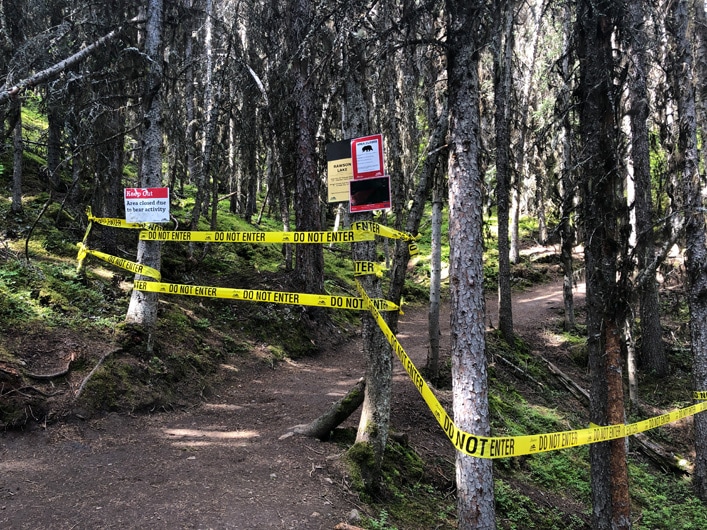
In fact, Banff National Park regularly publishes temporary bear warnings and closures when animals are active in particular locations.
In 2026, Parks Canada issued warnings in several areas, including sections around Lake Minnewanka and Lake Louise.
Some involved bears feeding on natural food sources.
Others involved animals that had obtained food from people.
These warnings illustrate why checking trail conditions before leaving is important.
A trail that was perfectly suitable last weekend might have a temporary wildlife restriction today.
You can check current Banff National Park trail conditions.
For Kananaskis, review Alberta Parks advisories.
Don’t ignore a closure simply because you’ve already driven an hour to reach the trailhead.
When is bear season in Alberta?
Bears generally become more active in spring as they emerge from winter dens.
Activity continues through summer and fall.
In late summer and autumn, bears increase their feeding in preparation for winter.
That period can be particularly important for hikers because bears may spend long periods feeding on berries and other food.
Winter denning reduces the likelihood of encountering active bears, but exact timing varies.
Not every bear enters or leaves its den on the same date.
And activity can occur outside the periods people normally expect.
If you’re hiking in bear habitat, it’s wise to maintain good wildlife safety habits rather than assuming a particular month is automatically safe.
Are hiking trails safer when they’re busy?
Busy trails can sometimes reduce the chance of surprising wildlife because human activity creates more noise.
But they aren’t completely free of risk.
Bears may still move near trailheads and popular destinations.
And some animals become accustomed to people when they repeatedly encounter human activity.
That can create additional problems, particularly if food is involved.
A bear that learns to associate people with snacks or garbage may become more willing to approach visitors.
That’s why food storage and wildlife rules matter.
Even on a short hike, don’t leave food unattended.
Pack out garbage.
And never feed a bear or any other wild animal.
Should you avoid hiking in Alberta because of bears?
No.
But you should prepare appropriately.
Alberta has some of the most beautiful hiking scenery in Canada.
Avoiding every mountain trail because bears live in the region would mean missing an enormous amount of what makes the province special.
The better approach is learning how to reduce risk.
Hike with others when possible.
Make noise in areas with poor visibility.
Carry accessible bear spray and know how to use it.
Keep pets under control.
Stay away from wildlife and food sources.
And check for current warnings before heading out.
These habits eventually become part of normal hiking preparation.
Just like checking the weather or bringing enough water.
You don’t need to feel terrified.
You need to be informed.
What should you do after a close bear encounter?
Once you’re safely away, report the encounter to the appropriate park authority.
For Banff National Park, Parks Canada operates a dispatch service at 403 762 1470.
The service accepts reports of wildlife sightings, close encounters and concerning animal behaviour.
For Jasper National Park, wildlife reports can be made to Jasper Dispatch at 780 852 6155.
Outside the national parks, follow Alberta Parks or provincial wildlife reporting guidance for the relevant area.
If a person is injured or there is an immediate emergency, call 911 when you have service.
Cell coverage is limited in many parts of the Rockies.
For remote backcountry trips, a satellite communication device can provide an additional way to request assistance.
When reporting an encounter, provide the location, approximate time, animal description and behaviour.
Accurate information helps park staff assess whether warnings or closures are necessary.
What would I do before hiking in bear country?
I would start by checking the trail conditions and any active wildlife warnings.
Then I’d make sure the trail is suitable for the group.
I’d carry bear spray where I can reach it quickly.
I’d also make sure that everyone understands the basic encounter guidance.
If hiking with friends, I’d stay close enough that the group can move together.
I’d make noise in forested areas and pay particular attention near blind corners, streams and berry patches.
I’d keep food packed away when not eating and carry all garbage back out.
And if I encountered fresh bear signs or a bear behaving unpredictably, I’d be willing to turn around.
That’s something more hikers should be comfortable doing.
You don’t have to finish every trail simply because you started it.
Sometimes the smartest outdoor decision is deciding that today isn’t the right day.
So, how dangerous are bears while hiking in Alberta?
Bears deserve respect, but their presence shouldn’t stop you from enjoying the outdoors.
Most hiking trips in Alberta happen without a serious wildlife encounter.
Bears generally prefer to avoid people.
And many encounters can be prevented by making noise, travelling in groups, managing food properly and staying alert.
But if you do see a bear, the situation should never be treated casually.
Give it plenty of room.
Never approach for photographs.
Never run away.
And know how to respond if the animal becomes threatening.
The beautiful thing about hiking in Alberta is that you’re exploring landscapes where wildlife still lives naturally.
The mountains aren’t an amusement park.
The forests aren’t controlled environments.
And that’s part of what makes them extraordinary.
You might spend an entire day hiking without seeing anything larger than a squirrel.
Or you might spot a bear moving across a distant hillside, completely uninterested in your presence.
Either way, remember that you’re a visitor in its home.
Enjoy the scenery.
Respect the wildlife.
And make the kind of decisions that allow both you and the bears to continue enjoying these mountains safely.
