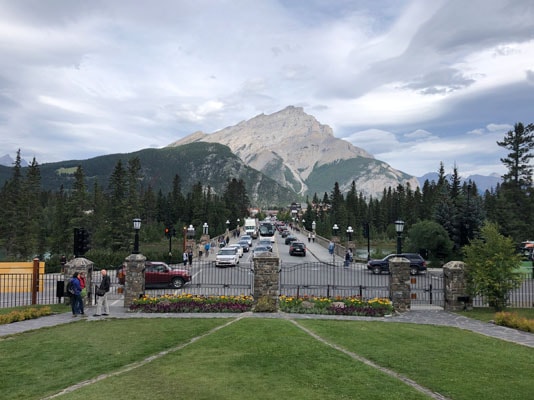
Spending $300 on a hotel room just to sleep for eight hours doesn’t sound particularly appealing.
Especially when you’re visiting Banff, where the mountains are the attraction and you’d rather spend your money exploring them.
So the idea seems simple.
Fold down the back seats, throw in a sleeping bag, find a quiet parking lot and wake up surrounded by the Canadian Rockies.
No hotel reservation. No expensive accommodation. Just you, your car and a mountain view.
There’s only one problem.
Sleeping in your car in Banff is generally only permitted at an authorized campsite in a designated campground.
You cannot simply park at a trailhead, lakeside parking lot or roadside viewpoint and spend the night.
And yes, that rule applies even if you’re not pitching a tent.
The good news is that sleeping in your vehicle can still be a practical way to save money while visiting Banff. You just need to know where it’s allowed.
Is sleeping in your car illegal in Banff National Park?
Sleeping inside a car isn’t automatically illegal.
Where you do it is what matters.
Parks Canada states that camping, including sleeping inside a vehicle, is permitted only in designated campgrounds.
That means you cannot use ordinary parking lots, roadside pullouts, trailheads or day use areas as overnight campsites.
You can read the exact wording on the official Banff National Park regulations page.
This rule applies whether you’re travelling in a regular sedan, an SUV, a campervan or a large motorhome.
It also applies whether you’re sleeping on a mattress, reclining the driver’s seat or using a professionally converted camper.
The vehicle doesn’t need to look like a campsite for the rules to apply.
If you’re using it as overnight accommodation, you’re camping.
And in Banff National Park, camping belongs in an authorized campground.
But what if you’re just parked overnight?
This is where people get confused.
Parking and camping are not necessarily the same thing.
For example, certain parking locations may allow a vehicle to remain parked overnight in accordance with their posted rules.
But that doesn’t automatically mean someone is permitted to sleep inside the vehicle.
The Town of Banff has its own regulations governing camping on streets and public places.
Its bylaws define camping to include sleeping in a vehicle, and camping is generally prohibited on public streets and public places without authorization.
You can review the current rules through the Town of Banff’s official bylaws page.
So leaving your car somewhere overnight while you’re staying in a hotel is different from using that same parking space as your bedroom.
It’s an important distinction, especially if you find an online tip recommending a free parking lot.
Free parking does not mean free camping.
Can you sleep in your car at a Banff campground?
Yes, generally, if you have an authorized campsite suitable for your vehicle and comply with the campground’s rules.
You don’t necessarily need to bring a tent.
For example, if you reserve an appropriate vehicle accessible campsite, you may be able to sleep inside your car instead of setting up a tent.
But there’s one detail worth checking before booking.
Not every campsite is suitable for sleeping in a vehicle.
Some campsites are designed for people who walk in from a parking area.
Others are reserved for larger camping units or have specific equipment restrictions.
At Lake Louise, for example, Parks Canada separates camping facilities for hard sided and soft sided equipment because of bear activity.
The hard sided campground has specific restrictions on what types of camping units are permitted.
A regular passenger car should not automatically be assumed to qualify as an approved camping unit at every site.
When booking, select a site suitable for your vehicle and confirm with Parks Canada if you’re unsure whether sleeping inside your particular vehicle is permitted.
The official Banff National Park campground directory explains the campground facilities and equipment restrictions.
Where can you legally sleep in your car near Banff?
If you’re trying to spend a night inside Banff National Park, I would start by looking at the established campgrounds rather than hunting for an unofficial parking spot.
Two options are particularly worth knowing about.
Tunnel Mountain Village II
This is probably the first campground I would investigate for a vehicle based overnight stay near Banff.
Tunnel Mountain Village II sits only about 2.5 kilometres from the town of Banff.
It’s close enough that you can spend the day exploring town, enjoy dinner and return to your campsite without making a long drive.
Parks Canada lists 209 campsites with electrical service, along with washrooms, drinking water, cooking shelters and access to public transportation.
Even better, the campground operates year round.
That makes it especially useful outside the normal summer camping season.
The standard electrical camping fee is listed at $40 per night for 2026, before applicable reservation fees and park admission.
If your goal is to avoid expensive hotels while spending time in Banff, it’s worth comparing available campsites with accommodation prices.
Just make sure your chosen site accepts your type of vehicle and camping setup before paying.
Two Jack Main Campground
Two Jack Main is another option during its operating season.
It sits about 10 kilometres from the town of Banff, close to Lake Minnewanka.
The setting feels more like traditional camping than staying near the busy town centre.
You have forest, mountain scenery and easy access to outdoor activities.
Parks Canada lists unserviced campsites suitable for tents and smaller recreational vehicles, along with basic campground facilities.
The standard unserviced camping fee is listed at $26.75 per night for 2026.
That’s considerably less than many hotel rooms in Banff.
But Two Jack Main is seasonal.
Its published 2026 operating period ended in early September, so it is not a solution for an October or winter trip.
Again, check whether your intended vehicle sleeping arrangement fits the type of campsite you are reserving.
For campground dates, facilities and current fees, use the Parks Canada camping information.
Do you need to reserve a campsite?
I would strongly recommend it.
Banff is one of Canada’s most popular national parks, and campgrounds can fill quickly during the summer.
This becomes particularly frustrating when somebody arrives after a long drive, discovers accommodation is expensive and assumes they can simply sleep in the car.
By that point, the campgrounds might already be full.
And unlike some destinations, Banff doesn’t allow you to solve the problem by finding a quiet roadside parking area.
Some campgrounds offer spaces allocated on arrival, while others require advance reservations.
Policies vary by campground and season.
You can make reservations through the Parks Canada reservation website.
Before booking, check the campground’s operating dates, equipment restrictions and available facilities.
A little planning is much easier than searching for somewhere to sleep at 11 at night.
Can you sleep in your car at Lake Louise?
Not in the ordinary visitor parking lots.
This includes the parking area at Lake Louise Lakeshore.
Parks Canada specifically states that camping is not permitted in the Lake Louise parking lots.
Overnight parking may be authorized for certain visitors holding valid backcountry permits, but that is not permission to camp inside the vehicle.
The distinction matters.
Someone leaving a vehicle overnight while hiking into the backcountry has a different arrangement from someone planning to spend the night sleeping in the parking lot.
If you want to stay overnight near Lake Louise, book appropriate accommodation or a legal campsite.
The Lake Louise parking information explains the parking restrictions and transportation arrangements.
What about Johnston Canyon, Lake Minnewanka or scenic viewpoints?
The same general rule applies.
These are places to visit during the day, not unofficial overnight campgrounds.
A parking lot beside a beautiful attraction might look especially tempting in the evening.
The day visitors leave.
Traffic becomes quiet.
The mountains look incredible.
And you begin thinking about how nice it would be to wake up there.
Unfortunately, a beautiful view doesn’t create an exception to Parks Canada’s camping regulations.
You can’t turn a trailhead or day use parking lot into a campsite simply because there are no other cars around.
If you want to stay overnight, use a designated campground.
Can you sleep in a campervan in Banff?
Yes, at an authorized campsite suitable for the campervan.
But renting a campervan doesn’t give you special permission to camp wherever you want.
This seems to surprise some visitors.
They rent a converted van in Calgary, drive into Banff and assume the whole advantage is being able to sleep beside any lake or mountain viewpoint.
That is not how camping regulations work in the national park.
A campervan is still a vehicle.
When it’s being used for overnight accommodation, the camping restrictions apply.
Some campgrounds are especially convenient for campervans because they have vehicle accessible sites, electrical connections and other facilities.
Check the maximum vehicle size, permitted equipment and campsite rules before booking.
Is it okay to sleep in a Walmart parking lot?
This question comes up whenever people start looking for inexpensive road trip accommodation.
Some retail stores elsewhere in North America have historically allowed overnight RV parking with management permission.
That doesn’t mean all Walmart locations do.
It also doesn’t override municipal bylaws, national park rules or private property restrictions.
There is no general right to camp overnight in a retail parking lot.
If you’re considering any private parking area outside the national park, you need the owner’s explicit permission and confirmation that local regulations allow the intended use.
Don’t assume that because another camper posted about a parking lot several years ago, it’s still permitted today.
And remember that a place where overnight vehicle parking is allowed may still prohibit overnight camping.
Those are different permissions.
What about sleeping in your car in Canmore?
Canmore is outside Banff National Park, but that does not mean you can freely camp on its residential streets or public parking lots.
The Town of Canmore has municipal restrictions on sleeping in vehicles during overnight hours in public areas.
So driving from Banff to Canmore and looking for a quiet residential street isn’t a reliable legal workaround.
If you’re staying in Canmore, look for a legitimate campground or accommodation property where vehicle camping is authorized.
You can review current regulations on the Town of Canmore website.
This is one of the most important things to understand about overnight vehicle camping in the Bow Valley.
The rules don’t simply disappear when you cross a town boundary.
Can you camp for free on Crown land outside Banff?
Possibly, but you need to be careful about where you go.
Alberta does permit random camping on certain provincial public lands outside national parks.
Some locations require a Public Lands Camping Pass.
Others have additional access restrictions or designated camping areas.
But Banff National Park is not part of Alberta’s provincial random camping system.
You cannot use an Alberta Public Lands Camping Pass to camp randomly inside Banff.
And land that appears undeveloped on a map is not necessarily land where camping is permitted.
If you’re considering Crown land camping outside the park, use the Government of Alberta’s official public land camping information.
Confirm that the location is open for camping, that you can legally access it and that you have any required permits.
For someone visiting Banff for a short vacation, I would usually recommend an established campground instead of spending hours researching unfamiliar public land.
The savings may not be worth the extra driving and uncertainty.
What if you’re too tired to drive and need a nap?
This deserves a separate explanation.
There’s a difference between planning an overnight camping trip and unexpectedly becoming too tired to drive safely.
If you’re dangerously tired, don’t keep driving simply because you’re worried about camping rules.
Find somewhere safe to stop.
Rest and assess your options.
If you need to remain in the area overnight, contact Parks Canada or local authorities for guidance on where you can legally stay.
Don’t assume that a roadside rest stop is automatically authorized for an entire night of camping.
But don’t continue driving when you’re struggling to stay awake either.
Safety comes first.
The smartest approach is to plan your overnight accommodation before you get tired, not after.
How much money can you save by sleeping in your car?
Potentially quite a bit.
Accommodation in Banff can become expensive during summer weekends, holidays and popular travel periods.
If hotel rooms are selling for several hundred dollars per night, an established campground can be a much cheaper option.
For example, Parks Canada’s published 2026 fees include:
Camping option
Standard nightly fee
Tunnel Mountain electrical site
$40
Tunnel Mountain unserviced site
$34
Two Jack Main unserviced site
$26.75
Two Jack Lakeside unserviced site
$34
These are standard published rates, not guaranteed availability or confirmation that every site accepts a car sleeping setup. Reservations, fire permits and other charges can increase the final cost.
You also need a valid national park entry pass.
As of October 2026, regular daily admission is $12.25 per adult or $24.50 for a family or group travelling together in one vehicle, while eligible youth enter free.
So a campsite isn’t completely free.
But it can still be dramatically cheaper than booking a hotel during peak season.
Current fees are listed on the official Banff National Park fees page.
Is sleeping in your car comfortable?
That depends on the vehicle.
And how tall you are.
A minivan or SUV with seats that fold flat can work surprisingly well.
A small sedan with a sloping back seat is another story.
For one night, almost anything might feel manageable.
For several nights, comfort starts to matter.
A proper sleeping pad makes a huge difference.
So does having enough space to stretch out.
You’ll also want somewhere to keep your bags without piling everything on top of yourself.
Window coverings can provide privacy and help block early morning light.
And don’t underestimate how cold the vehicle can become overnight.
Sleeping in your car during winter is much more serious
Summer car camping and winter car camping are not the same experience.
In the middle of July, your biggest problem might be getting comfortable.
In December, staying warm becomes a genuine safety concern.
Banff temperatures can drop well below freezing overnight.
A vehicle offers protection from wind and snow, but its interior still cools considerably without a safe heat source.
Bring proper cold weather sleeping equipment.
Don’t rely on a few ordinary household blankets during freezing conditions.
Avoid using fuel burning stoves or heaters inside the vehicle because of carbon monoxide and fire hazards.
Never sleep with the engine running as a way to keep warm.
If you’re planning winter vehicle camping, make sure your equipment and experience are appropriate for the expected temperatures.
For a first attempt, I would choose a mild night at an established campground rather than experimenting during a January cold snap.
Being close to Banff doesn’t make severe winter conditions any less dangerous.
Remember that Banff is bear country
Food storage matters even when you’re sleeping inside a vehicle.
Banff National Park is home to black bears, grizzly bears and other wildlife.
Parks Canada requires campers to keep food, garbage, cooking equipment and other wildlife attractants properly secured.
Food and scented items should never be left unattended outside.
A hard sided vehicle can be used for secure food storage when properly closed, but keep the campsite clean and follow any campground specific food storage instructions.
Don’t leave cooking equipment or garbage outside overnight.
Don’t feed wildlife.
And don’t assume that a developed campground means animals won’t visit.
One of the advantages of staying in an established campground is that facilities and rules are designed to reduce wildlife conflicts.
Use them.
What if all the Banff campgrounds are full?
Don’t count on finding a secret legal parking lot.
Start by checking cancellations through Parks Canada.
If nothing is available, compare accommodation outside the national park or consider changing your travel dates.
Weekday stays may offer more flexibility than popular summer weekends.
Travelling during quieter periods can also make accommodation easier to find.
And if you’re planning a longer road trip, sometimes adjusting the order of your destinations is enough to solve the problem.
What I wouldn’t do is arrive without a plan and assume you’ll figure out a place to sleep once it gets dark.
That’s how a budget vacation turns into a stressful evening.
Is sleeping in your car in Banff worth it?
If you enjoy camping and have a vehicle that’s comfortable enough to sleep in, it can make a lot of sense.
You save money on accommodation.
You can spend more of your budget on activities.
You wake up close to the mountains.
And you don’t have to pack a full tent setup for every overnight stay.
But there is one thing I wouldn’t try to save money on.
The legal campsite.
Banff is not the kind of destination where you can casually pull into an empty parking lot and assume nobody will care.
Parks Canada has clear regulations, and the Town of Banff has its own rules about camping in public places.
The best plan is also the simplest.
Reserve an appropriate campsite.
Confirm that your vehicle sleeping setup is permitted.
Bring the right equipment.
And enjoy Banff without wondering whether somebody is going to knock on your window at two in the morning.
Because waking up surrounded by the Canadian Rockies sounds pretty wonderful.
Waking up to a bylaw officer explaining why you can’t sleep there?
Not quite the mountain adventure you were hoping for.
