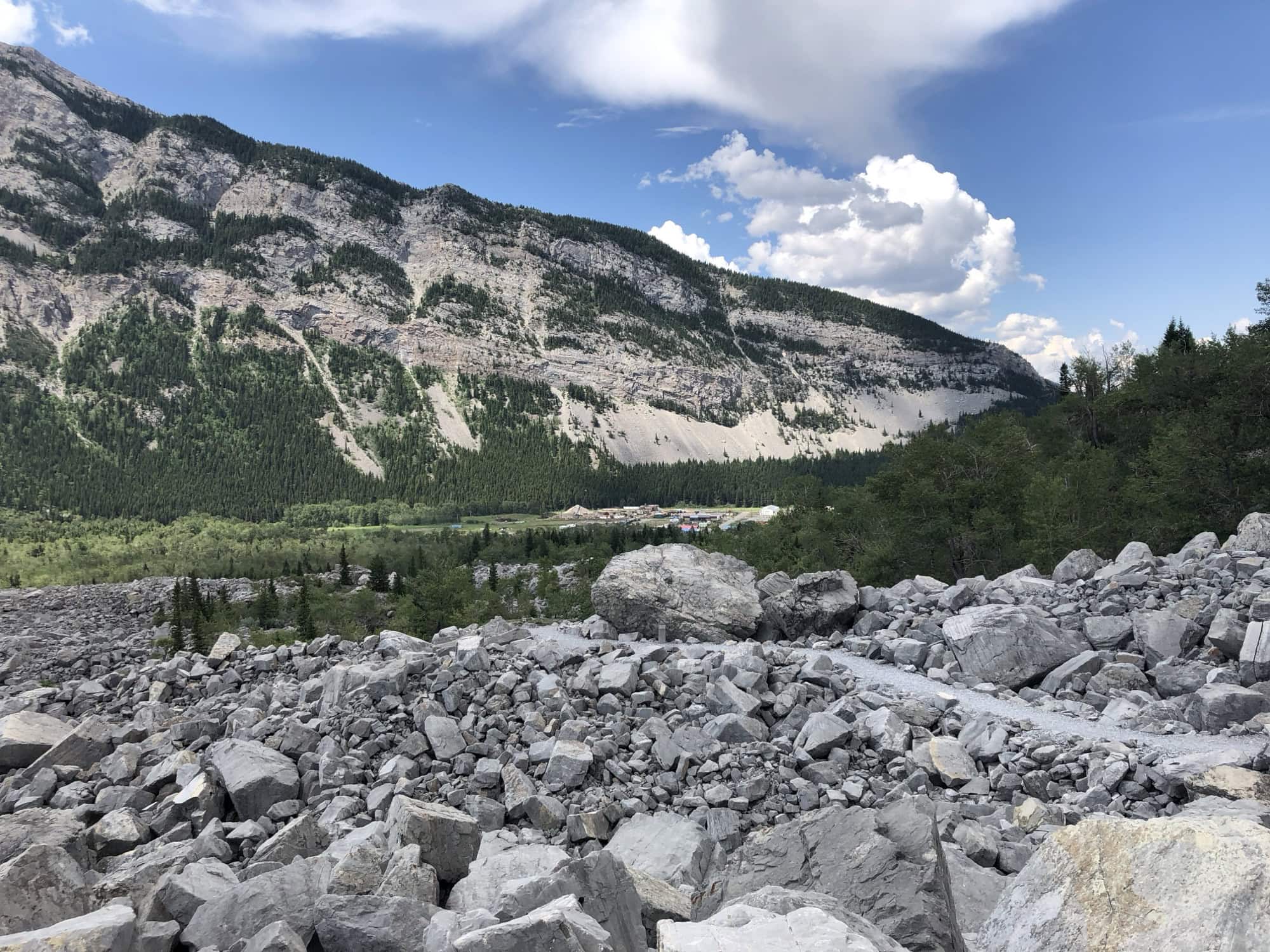
Imagine driving through the mountains of southern Alberta when you suddenly notice something strange.
An enormous section of the valley is covered in broken grey limestone. Not a few fallen rocks beside the road, but millions of tonnes of rubble stretching across the landscape.
Above it stands a mountain with a massive piece missing.
At first, it almost looks like an enormous construction site abandoned halfway through a project.
Then you learn what happened here.
In the early morning hours of April 29, 1903, part of Turtle Mountain collapsed onto the town of Frank. Within roughly 100 seconds, an enormous rock avalanche had swept across the valley, burying homes, railway tracks and mining infrastructure.
More than 90 people lost their lives.
Today, the remains of that disaster are still visible in the Crowsnest Pass, and visitors can explore the remarkable landscape while learning about one of the most tragic events in Canadian history.
Frank Slide is one of those Alberta attractions that looks interesting from the highway but becomes much more memorable once you understand its story.
And unlike many famous destinations in the Rockies, you don’t need a difficult hike or a complicated reservation to appreciate it.
So is Frank Slide worth visiting from Calgary?
Yes, particularly if you enjoy unusual landscapes, history and scenic road trips. But there are a few things worth knowing before making the drive.
Where is Frank Slide in Alberta?
Frank Slide is located in the Crowsnest Pass in southwestern Alberta, near the community of Frank.
The site sits along Highway 3, close to the British Columbia border.
It’s part of a mountain region that looks and feels quite different from Banff or Canmore.
Instead of large resort towns and famous turquoise lakes, the Crowsnest Pass has historic mining communities, forested mountains and a landscape shaped by Alberta’s industrial past.
Frank Slide is one of the area’s most recognizable landmarks.
You can see the enormous rubble field from the highway, but the best way to understand what happened is to stop at the Frank Slide Interpretive Centre.
The centre overlooks the debris field and provides exhibits about the disaster, the people who lived in Frank and the geological forces that caused the mountain to collapse.
It’s located at 2325 153rd Street, approximately 1.5 kilometres off Highway 3.
You can find directions and visitor information on the official Frank Slide website.
How far is Frank Slide from Calgary?
Frank Slide is roughly 220 to 250 kilometres from Calgary, depending on where you’re starting and which route you choose.
The drive typically takes about two and a half to three hours in normal conditions.
That makes it a reasonable day trip, especially if you leave in the morning.
One common route takes you south from Calgary toward Fort Macleod, then west along Highway 3 into the Crowsnest Pass.
Another option involves travelling south along Highway 22, often called the Cowboy Trail, before connecting with Highway 3.
The scenery changes considerably as you approach the mountains.
You’ll pass through open prairie and foothills before entering the mountain valleys of southwestern Alberta.
The Crowsnest Pass has a different atmosphere from the busy mountain destinations west of Calgary.
There are smaller communities, historic buildings and reminders of the coal mining industry that shaped the region.
Then, as you approach Frank, you’ll notice the enormous field of broken rock.
Even without knowing the history, it’s difficult to miss.
And once you understand what happened, the landscape becomes even more remarkable.
What happened at Frank Slide?
The story begins in the early 1900s, when coal mining was an important industry in the Crowsnest Pass.
The town of Frank had developed near the base of Turtle Mountain.
People lived and worked there, families built homes, and the local economy revolved around the nearby coal mine.
On April 29, 1903, at approximately 4:10 in the morning, the eastern face of Turtle Mountain collapsed.
The rock avalanche moved across the valley at an extraordinary speed.
According to the Frank Slide Interpretive Centre, the rocks may have been travelling as fast as 120 kilometres per hour.
Within about 100 seconds, the slide had buried approximately three square kilometres of land.
Homes were destroyed.
Railway tracks disappeared beneath the rubble.
Mining facilities were overwhelmed.
And part of the town of Frank was buried.
It remains Canada’s deadliest rockslide.
What’s particularly striking is how quickly everything happened.
There was almost no time for the people living directly in the path of the avalanche to escape.
One moment, the town was sleeping beneath the mountain.
Less than two minutes later, part of it was gone.
How many people died in the Frank Slide?
The Frank Slide Interpretive Centre estimates that more than 90 people were killed.
However, the exact number has never been established.
Many victims were buried beneath enormous quantities of rock, and most of their remains were never recovered.
The rubble reached depths of approximately 45 metres in some areas.
That’s deeper than many visitors realize when looking across the debris field today.
It’s also important to understand that Frank wasn’t completely destroyed.
The town had approximately 600 residents at the time.
Much of the community lay outside the direct path of the rockslide.
Hundreds of residents survived because their homes were not struck.
Others survived despite being in areas affected by the disaster.
The tragedy has sometimes been exaggerated in popular stories, with claims that the entire town disappeared overnight.
The truth is more complicated.
Part of Frank was destroyed, and the loss of life was devastating.
But many residents continued living in the community afterward.
The official Frank Slide history and questions page explains the disaster and addresses several myths that developed over the years.
Why did Turtle Mountain collapse?
This is one of the most fascinating parts of the story.
At first, you might assume an earthquake caused the disaster.
Or perhaps a mining explosion.
But the primary cause was the mountain’s unstable geological structure.
Turtle Mountain had been shaped by enormous geological forces over millions of years.
Its layers of sedimentary rock had been folded and fractured during the formation of the Rocky Mountains.
A major fault ran through the mountain, weakening its structure.
Over time, erosion, water entering cracks and repeated freezing and thawing contributed to instability.
Eventually, a large section of the eastern slope could no longer support itself.
Gravity took over.
And the mountain collapsed.
Coal mining was initially blamed for the disaster.
Later scientific research identified mining activity as a possible contributing factor, but the mountain’s unstable geology was the main cause.
The Alberta Geological Survey provides a detailed explanation of Turtle Mountain’s geology and the processes involved in the collapse.
You don’t need to understand every geological term to appreciate what happened.
When you stand in front of Turtle Mountain and see the enormous missing section, the scale becomes clear.
A piece of an entire mountain came down.
And the evidence is still sitting in the valley more than a century later.
How much rock fell during Frank Slide?
The numbers are difficult to imagine.
The Frank Slide Interpretive Centre estimates that approximately 110 million metric tonnes of limestone fell from Turtle Mountain.
Geological studies have produced different estimates depending on the methods used, but all describe an extraordinary quantity of rock.
The debris covered roughly three square kilometres of the valley floor.
Some rocks were carried kilometres from the mountain.
The slide was powerful enough to cross the Crowsnest River valley and bury sections of railway infrastructure.
Today, the rubble field looks almost like an enormous frozen river made of stone.
There are boulders everywhere.
Some are relatively small.
Others are enormous blocks of limestone.
And behind them stands the exposed mountain face where the collapse began.
Photographs can show the general appearance, but it’s difficult to appreciate the scale until you’re looking at the landscape in person.
That’s one of the reasons Frank Slide is worth visiting.
You don’t just read about the disaster.
You can see the physical evidence spread across the valley.
Is Frank Slide worth visiting if you don’t enjoy history?
Yes, because the scenery itself is unusual.
You don’t need to be particularly interested in geology or Canadian history to appreciate the landscape.
The enormous debris field creates a dramatic contrast with the surrounding green mountains.
It’s unlike the scenery you normally associate with Alberta.
There are no turquoise lakes or postcard perfect alpine meadows in the middle of the slide.
Instead, you’re looking at a chaotic landscape of broken limestone that has remained visible for more than 120 years.
It’s fascinating from a photography perspective.
The surrounding mountains add to the scenery, and the exposed rock formations create unusual shapes and textures.
But history is what gives the place its emotional impact.
Without the story, Frank Slide is an impressive collection of rocks.
Once you understand what happened, those same rocks become the remains of a disaster that changed an entire community.
That’s when the visit becomes much more meaningful.
Visit the Frank Slide Interpretive Centre
If you’re making the drive from Calgary, I would strongly recommend visiting the interpretive centre rather than simply stopping for a few photographs.
The building sits above the slide area and offers an excellent view of the surrounding landscape.
Inside, visitors can learn about the history of the town, the geology of Turtle Mountain and the events of April 29, 1903.
There are displays explaining the coal mining industry, photographs of the original community and stories from people who survived the disaster.
The centre also includes interactive exhibits and a theatre presentation.
According to the official visitor information, exploring the galleries and watching the approximately 30 minute film typically takes around one to one and a half hours.
That makes it manageable even during a day trip.
You don’t need to spend an entire afternoon inside.
But allowing enough time to experience the exhibits will make the outdoor landscape much more interesting afterward.
Is the museum suitable for children?
Yes.
The Frank Slide Interpretive Centre offers interactive displays, geological exhibits and information designed for a range of visitors.
Children may find the enormous rock formations particularly fascinating.
The centre also has exhibits that explain the forces responsible for the mountain collapse.
However, remember that the site tells the story of a deadly disaster.
Some presentations discuss the loss of life and the experiences of survivors.
Parents may want to consider whether younger children will be comfortable with that subject matter.
For school aged children who enjoy history and science, the centre can be an excellent educational stop.
It’s also a good reminder that interesting Alberta attractions don’t always involve amusement rides or expensive outdoor adventures.
Sometimes learning about an event that actually happened can be just as memorable.
How much does the Frank Slide Interpretive Centre cost?
For 2026, the official admission prices are:
Adult admission for visitors aged 18 to 64 is $18.
Seniors aged 65 and older pay $14.
Youth aged 7 to 17 pay $11.
Children aged 6 and under enter free.
A family admission covering two adults and their children, up to a maximum of eight people, costs $45.
The centre also recognizes certain admission programs and discounts.
For example, eligible active Canadian military personnel with a CFOne Card receive free admission.
Visitors can also use an applicable Experience Alberta’s History Annual Pass.
These are the published rates for 2026, and they may change in future seasons.
For the latest admission prices, check the Frank Slide Interpretive Centre visitor information.
You don’t need a Banff National Park pass or Parks Canada Discovery Pass to visit Frank Slide.
The interpretive centre is a provincial historic attraction, not part of Banff National Park.
If you’re planning several historic site visits in Alberta, it may be worth comparing the annual history pass with individual admission fees.
Can you see Frank Slide without entering the museum?
Yes, the slide itself is visible from public roads and outdoor viewpoints in the area.
You don’t have to purchase a museum admission ticket simply to appreciate the enormous scar on Turtle Mountain or see the debris field from the highway.
However, the interpretive centre gives the landscape much more context.
There are outdoor viewpoints and interpretive panels near the building, along with a trail through the slide area.
If you’re short on time, enjoying the views outside may still be worthwhile.
But if this is your first visit, I would recommend going inside when the centre is open.
The stories and exhibits explain details you would probably never understand from looking at the rocks alone.
And given the amount of time it takes to drive from Calgary, paying for the full experience may be worthwhile.
Walk the Frank Slide interpretive trail
One of the best parts of visiting is the opportunity to explore the rockslide landscape on foot.
The Frank Slide Interpretive Centre has an approximately 1.5 kilometre trail that takes visitors through the rocks.
It’s a relatively short walk compared with many mountain hiking trails in Alberta.
But don’t assume that means the surface will always be easy.
You’re walking through a rocky landscape, and conditions can change depending on the weather.
The area may be exposed to wind, rain, snow and icy conditions.
Wear shoes with good traction.
And take your time.
The experience is very different from walking through an ordinary forest.
Instead of trees and soft ground, you’re surrounded by broken limestone.
The trail helps you appreciate just how far the rocks travelled and how much material came down from the mountain.
Some of the boulders are enormous.
Others are piled together in ways that make the landscape look almost artificial.
It’s hard to believe that this entire field of rock was created during an event lasting less than two minutes.
For visitors who enjoy photography, the trail also provides opportunities to capture the surrounding mountains and unusual terrain.
Just stay on the designated route.
The debris field is part of a protected historic landscape, and climbing over unstable rocks or creating shortcuts isn’t a good idea.
Is the Frank Slide trail difficult?
The official trail is relatively short, but it’s best approached as a walk on uneven natural terrain rather than a paved city pathway.
You don’t need to be an experienced mountaineer to explore the designated route in suitable conditions.
However, visitors with mobility limitations may find the rocky sections challenging.
The interpretive centre itself is wheelchair accessible.
The pathway from the parking lot to the building is also accessible, and the centre has accessible washrooms.
But that doesn’t mean the outdoor rockslide trail has the same level of accessibility.
If someone in your group has mobility concerns, I would contact the centre before visiting.
You can still enjoy impressive views of Turtle Mountain and the debris field without completing the full trail.
There’s no need to push yourself onto unsuitable terrain just to get a photograph.
The landscape is impressive from several viewpoints.
Is Turtle Mountain still dangerous?
This is a question that naturally comes to mind when you’re standing beneath a mountain that once collapsed.
And the answer is worth understanding.
Turtle Mountain has been studied extensively since the 1903 disaster.
Scientists have identified areas of continuing movement and instability.
The Alberta Geological Survey monitors the mountain using specialized instruments that track changes in the rock mass.
The monitoring system helps researchers understand how the mountain is behaving and whether movement is changing.
According to the Frank Slide Interpretive Centre, scientists expect that another significant rock avalanche could occur at some point in the future.
However, the available research does not suggest that a catastrophic slide is imminent under current observed conditions.
That distinction matters.
Turtle Mountain is not completely motionless.
But it is also not accurate to tell visitors that the entire mountain is about to fall at any moment.
Scientific monitoring is an important part of managing the hazard.
And the Frank Slide Interpretive Centre provides an opportunity to understand how knowledge of the mountain has developed since 1903.
It’s fascinating to think that the same landscape is both a historic attraction and an active subject of geological research.
Is Frank Slide open all year?
Yes, the Frank Slide Interpretive Centre operates throughout the year, although opening days vary by season.
For the 2026 summer operating period, the centre is open daily from 10 AM to 5 PM through Thanksgiving Monday, October 12.
Beginning October 13, 2026, the published fall, winter and spring schedule runs from Tuesday through Sunday, 10 AM to 5 PM.
Mondays are normally closed during that period.
The centre also closes on certain holidays, including Christmas Eve, Christmas Day, New Year’s Day and Easter Sunday.
Special holiday schedules may apply.
You can check the current hours on the official Frank Slide website.
If you’re visiting during winter, remember that the outdoor trail may be affected by snow and ice.
The centre may still be open even when conditions are unsuitable for exploring the rocks on foot.
That’s one of the advantages of this attraction.
Unlike a destination that depends entirely on warm weather, Frank Slide still offers an interesting indoor experience during colder months.
When is the best time to visit Frank Slide?
For a first visit, I would generally recommend late spring through early fall.
May, June and September can be particularly appealing if you’re hoping for comfortable walking weather.
The surrounding mountains look beautiful as the landscape becomes greener.
The outdoor trail is usually more pleasant than during the coldest winter months, although conditions can still vary.
July and August are also good times to visit.
The main advantage is the warmer weather and longer daylight hours.
That gives you more flexibility if you’re travelling from Calgary.
You can explore the interpretive centre, walk the trail and still have time to enjoy the surrounding mountain scenery before heading home.
Autumn can be particularly beautiful.
The forests change colour, the air becomes cooler and the mountain landscape takes on a different atmosphere.
However, the Crowsnest Pass can experience strong winds and changing weather.
Bring an extra layer even if the forecast looks pleasant.
What about visiting in winter?
Winter is possible, especially if your main interest is the interpretive centre.
You can still learn about the disaster, explore the exhibits and enjoy views of Turtle Mountain when conditions permit.
But driving through the Crowsnest Pass during winter requires preparation.
Highway 3 can experience snow, ice, strong winds and reduced visibility.
If you’re travelling from Calgary, check 511 Alberta before leaving.
And don’t assume the outdoor trail will be suitable simply because the interpretive centre is open.
For someone visiting Frank Slide for the first time, warmer weather usually makes the experience easier.
How much time do you need at Frank Slide?
I would allow approximately two to three hours for a comfortable visit.
That gives you time to explore the interpretive centre, watch the film, enjoy the viewpoints and walk the outdoor trail if conditions permit.
You could spend less time.
But there’s no reason to rush.
If you’ve driven nearly three hours from Calgary, spending only fifteen minutes looking at the rocks seems like a missed opportunity.
The real value of visiting comes from combining the history with the landscape.
Start inside the centre.
Learn what happened.
Then step outside and look across the rubble.
You’ll see the scenery very differently after hearing the stories of the people who lived there.
If you’re particularly interested in geology or local history, you may want even more time.
For most casual visitors, though, a few hours is enough to enjoy the main attraction.
Can you visit Frank Slide on a day trip from Calgary?
Absolutely.
It’s one of the more manageable longer day trips from Calgary.
The drive is scenic, the attraction is easy to locate and you don’t need to dedicate an entire day to hiking.
I would leave Calgary in the morning and aim to arrive around the time the interpretive centre opens.
That gives you time to enjoy the exhibits before the afternoon.
After visiting the centre, spend some time outside exploring the viewpoints and trail.
Then have lunch before beginning the return journey.
If you want a more relaxed experience, you can spend additional time enjoying the scenery of the Crowsnest Pass.
But I wouldn’t try to squeeze too many unrelated attractions into the same day.
Remember that you’ll still have several hours of driving ahead of you.
A good day trip should feel enjoyable, not like an attempt to break a record for the number of places visited.
Is there food at Frank Slide?
The interpretive centre has basic visitor amenities, including washrooms, picnic tables and a gift shop with snacks and drinks.
But it isn’t a full restaurant destination.
If you’re planning to spend several hours in the area, I would bring water and a few snacks.
You can also find restaurants and other services in the surrounding Crowsnest Pass communities.
For a simple day trip, you could pack a lunch and enjoy it at a designated picnic area.
That keeps the trip affordable and gives you more flexibility.
Just remember that the area can be windy.
A picnic beside the mountains sounds lovely until your napkins start flying across the parking lot.
Check the weather before deciding whether an outdoor lunch is a good idea.
Can you bring a dog to Frank Slide?
Dogs are allowed on the grounds of the Frank Slide Interpretive Centre but are not permitted inside the building.
They must remain on a leash.
This is important if you’re planning to visit with your pet.
You may be able to enjoy the outdoor surroundings together, but you can’t bring your dog into the museum exhibits.
If you’re travelling with another person, you could arrange for someone to remain outside with the dog while the other person visits the centre.
But never leave a pet unattended in a vehicle during unsafe temperatures.
Summer heat can become dangerous quickly.
And winter temperatures in the Crowsnest Pass can be extremely cold.
If the interpretive centre is the main reason for your trip, arranging appropriate pet care beforehand may be the easiest solution.
Is Frank Slide suitable for families?
Yes, especially families with children who enjoy science, mountains and interesting historical stories.
The interpretive centre provides information about geology and the disaster through displays and presentations.
The outdoor scenery is also impressive.
Children may find it fascinating to learn that the enormous rocks surrounding them once formed part of a mountain.
However, parents should remember that the site tells the story of a real tragedy.
Some children may be upset by the accounts of people who lost their lives.
It’s worth approaching the visit with that in mind.
The outdoor trail also requires supervision.
The rocks can be uneven and slippery, and children shouldn’t climb into restricted or dangerous areas.
For families with school aged children, Frank Slide can be an excellent combination of education and outdoor sightseeing.
It’s one of those places where a history lesson feels much more memorable because you’re standing in the actual location.
What should you bring for a visit?
You don’t need specialized mountain hiking equipment for an ordinary visit to the interpretive centre.
But a few things will make the day more comfortable.
Comfortable walking shoes are useful if you plan to explore the outdoor trail.
Bring a jacket, even during summer, because the Crowsnest Pass can be windy.
Water and snacks are also worth packing.
If you’re visiting during colder months, wear appropriate winter clothing and footwear with good traction.
And if you’re driving from Calgary, make sure your vehicle is prepared for the expected conditions.
A few useful items include a charged phone, drinking water, weather appropriate clothing and basic emergency supplies.
If you’re interested in photography, bring a camera.
The rubble field, Turtle Mountain and surrounding valley provide some dramatic opportunities for landscape pictures.
Just remember that the history of the site deserves respect.
It’s a place to appreciate and understand, not simply a backdrop for unusual photographs.
A surprising myth about the Frank Slide
One of the most famous stories associated with the disaster involves a baby girl nicknamed Frankie Slide.
According to the popular legend, she was the only survivor of the entire town.
It’s a dramatic story.
But it isn’t true.
The official Frank Slide Interpretive Centre explains that hundreds of people survived because most of the town lay outside the path of the avalanche.
There were also several remarkable survival stories involving people whose homes were affected.
Among them were young children who survived in extraordinary circumstances.
Over time, details from different stories became mixed together.
The result was the legend of Frankie Slide.
It’s an interesting example of how historical events can develop myths that are repeated for generations.
And it’s another reason visiting the interpretive centre is worthwhile.
You learn the real history rather than relying on stories that may have changed considerably over time.
What happened to the town of Frank after the disaster?
You might assume everybody abandoned the town immediately.
But that isn’t what happened.
Many residents remained after the rockslide.
The community continued developing, and its population eventually grew.
However, concerns about the stability of Turtle Mountain remained.
Scientists studied the mountain, trying to determine whether another large collapse could occur.
In 1911, a Royal Commission concluded that parts of Turtle Mountain remained unstable and that the original townsite was at risk.
The provincial government subsequently ordered buildings in Old Frank to be relocated.
Over the following years, many structures were moved or dismantled.
The community developed farther from the original location, and today’s Frank forms part of the Municipality of Crowsnest Pass.
That history adds another layer to the story.
Frank Slide wasn’t simply an event that happened one morning in 1903.
Its effects shaped the community for decades afterward.
And even today, the landscape remains a reminder of the complicated relationship between people, industry and the mountains around them.
Is Frank Slide better than visiting a regular museum?
It offers something quite different.
A traditional museum may have interesting exhibits, historical objects and photographs.
Frank Slide has those elements too.
But outside the building is the actual landscape where the event occurred.
You can see the mountain.
You can see the debris.
And you can begin to understand the scale of the disaster in a way that photographs alone cannot fully explain.
That’s what makes it special.
The exhibits and film provide the story.
The outdoor landscape provides the perspective.
Together, they create an experience that’s much more powerful than simply reading a historical description.
If you enjoy places where history and nature come together, Frank Slide is an excellent destination.
And unlike many mountain attractions, it doesn’t require spending hours climbing uphill to reach the main viewpoint.
Is Frank Slide worth visiting if you’ve already been to Banff?
Yes, because it’s a completely different experience.
Banff is famous for its turquoise lakes, dramatic mountain scenery and outdoor recreation.
Frank Slide is about something else entirely.
It’s a place where the landscape tells a story.
The mountains are beautiful, but they’re also a reminder that nature isn’t always gentle or predictable.
The Crowsnest Pass has a rich mining history, and Frank Slide is one of its most significant landmarks.
Visiting gives you a better understanding of a part of Alberta that doesn’t always receive the same attention as the national parks.
And if you’ve already spent plenty of weekends exploring Banff and Canmore, it’s refreshing to discover a destination with such a different character.
You don’t need another photograph of a blue lake to have a memorable Alberta road trip.
Sometimes an enormous field of grey limestone can be just as fascinating.
Is Frank Slide worth visiting from Calgary?
Yes.
It’s one of the most unusual historical attractions within a reasonable drive of Calgary.
The scenery is impressive, the history is fascinating and the interpretive centre helps explain an event that permanently changed the Crowsnest Pass.
You can explore the main attraction in a few hours without needing specialized hiking equipment or a complicated itinerary.
It’s suitable for a day trip, particularly during the warmer months when the outdoor trail is easier to enjoy.
And because the interpretive centre operates throughout the year, it’s also an option for visitors looking for something to do outside the summer travel season.
But I would recommend taking your time.
Don’t simply stop beside the highway, look at the rocks for five minutes and leave.
Visit the interpretive centre.
Learn about the people who lived in Frank.
Walk through the landscape if conditions are suitable.
Then look back toward Turtle Mountain.
There’s something deeply striking about seeing the enormous scar on the mountain and realizing that the entire landscape changed in less than two minutes.
More than a century later, the evidence is still there.
And that’s what makes Frank Slide worth the journey.
It’s not just another beautiful place in Alberta.
It’s a place that makes you appreciate how powerful the natural world can be, and how much history can remain hidden in a landscape we might otherwise drive past without a second thought.
