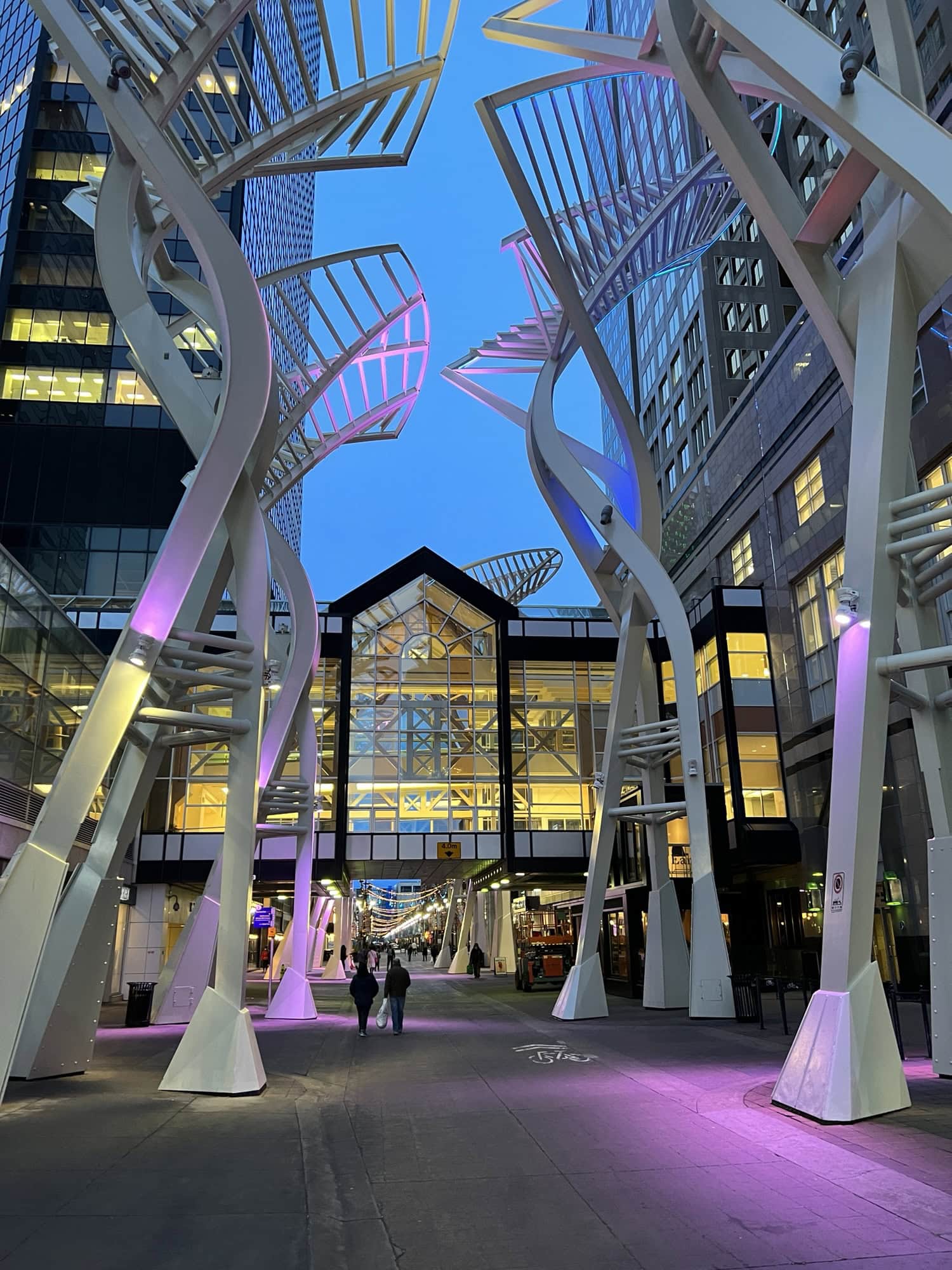
Calgary is a city where people sometimes drive five minutes to buy something from a store that’s only fifteen minutes away on foot.
And in some neighbourhoods, that’s understandable.
The roads are wide, shopping centres are spread out and walking to the nearest grocery store can feel like an unnecessary adventure.
But not every part of Calgary is like that.
There are neighbourhoods where you can walk to coffee shops, restaurants, grocery stores, parks and public transportation without constantly reaching for your car keys.
Some are busy and energetic.
Others have quieter residential streets with surprisingly convenient access to everything you need.
And if you’re trying to reduce transportation expenses, choosing a walkable neighbourhood could make a big difference to your monthly budget.
According to Walk Score, Calgary has an overall score of 39 out of 100, reflecting how dependent much of the city is on cars.
But the Beltline has a score of 91.
That’s an enormous difference within the same city.
So where should you live if walkability is a priority?
Here are the Calgary neighbourhoods I would investigate first.
1. Beltline is Calgary’s most walkable neighbourhood
If your main goal is living without a car, Beltline is one of the strongest choices.
Located immediately south of downtown, this neighbourhood has a large concentration of restaurants, shops, apartment buildings and everyday services.
You can walk along 17th Avenue SW, explore cafes, meet friends for dinner and reach numerous businesses without driving.
For many residents, the biggest advantage is having so much within a relatively small area.
You may be able to walk to work downtown.
You can shop for groceries nearby.
And you have access to Calgary’s downtown transit network.
Walk Score gives Beltline a score of 91 out of 100, making it the city’s highest ranked neighbourhood for walkability.
You can see the current neighbourhood comparison on Walk Score’s Calgary page.
What’s the downside of living in Beltline?
It can be busy.
Some streets have significant vehicle traffic, particularly near popular restaurants and nightlife areas.
Parking can also be expensive or inconvenient.
And because much of the housing consists of apartments and condominiums, you may have less private outdoor space than in a suburban home.
Noise varies considerably from building to building.
An apartment directly above a busy commercial street may feel very different from one along a quieter residential block.
I would visit potential rental properties during both the day and evening.
But if convenience matters more to you than having a large backyard, Beltline deserves serious consideration.
2. Mission is excellent for cafes, restaurants and river walks
Mission is one of Calgary’s most appealing neighbourhoods for people who enjoy walking.
Located just south of downtown, it has a lively commercial strip along 4th Street SW.
You’ll find cafes, restaurants, small businesses and everyday services.
And the Elbow River adds something special to the area.
You can enjoy riverside pathways and green spaces without travelling far from the neighbourhood.
Mission feels different from the busiest parts of Beltline.
It still has an urban atmosphere, but some streets feel more residential.
There are older apartment buildings, modern condominiums and historic properties.
Walk Score rates Mission at 76 out of 100.
That makes it one of Calgary’s more walkable communities.
Is Mission good without a car?
For many residents, yes.
If you work downtown or nearby, walking may be realistic.
Several essential services are accessible within the neighbourhood.
But Mission doesn’t have a CTrain station directly in its central commercial area.
Depending on your destination, you may need to walk farther to reach rail service or rely on buses.
That’s why the exact address matters.
An apartment located beside 4th Street may feel extremely convenient.
One farther from the commercial area may require longer walks.
Mission is particularly attractive if you enjoy restaurants, river pathways and an active city lifestyle.
3. Cliff Bungalow combines quiet streets with excellent walkability
Cliff Bungalow is immediately beside Mission and Beltline.
It’s a relatively small neighbourhood, but its location is excellent.
You have access to the restaurants and businesses along 4th Street and 17th Avenue without necessarily living on one of the busiest commercial streets.
Some parts of Cliff Bungalow feature older character buildings and mature trees.
That gives the neighbourhood a more established feeling.
Walk Score rates Cliff Bungalow at 85.
It’s among Calgary’s highest ranked communities for walkability.
Why would you choose Cliff Bungalow over Beltline?
Atmosphere.
If you like having restaurants and entertainment within walking distance but prefer a quieter residential setting, Cliff Bungalow may be more appealing.
The neighbourhood also offers good access to the Elbow River.
However, availability and housing prices can vary.
Some properties are older and may not have the same amenities as newer apartment buildings.
And the most convenient locations may attract strong demand.
I’d compare rental listings in both Cliff Bungalow and Mission rather than treating them as completely separate markets.
4. Sunnyside and Kensington are excellent for everyday walking
Kensington is one of Calgary’s most recognizable shopping and dining districts.
It’s not a single residential neighbourhood in the same way as Sunnyside or Hillhurst, but it forms an important commercial area serving both.
You’ll find independent shops, cafes, restaurants and other businesses.
The streets have a more traditional main street atmosphere than many suburban shopping centres.
And there are beautiful nearby walking routes along the Bow River.
Sunnyside also has its own CTrain station.
That’s a major advantage for people who need to commute beyond the immediate neighbourhood.
Can you live in Sunnyside without a car?
Yes, depending on your lifestyle and exact location.
Walk Score gives Sunnyside a score of 75, with a transit score of 74.
That combination is useful.
You can walk to local businesses and use the CTrain when you need to travel farther.
Downtown is also within walking distance from certain parts of the neighbourhood.
The nearby river pathways are wonderful for walking and cycling during suitable weather.
However, Sunnyside has a mixture of housing ages and types.
Some streets are quieter, while others experience more activity near the station and commercial areas.
And because the Bow River runs nearby, it’s worth reviewing flood risk information for any property you’re considering.
5. Bridgeland is a great choice for an urban neighbourhood with character
Bridgeland is located northeast of downtown, close to the Bow River.
It’s one of Calgary’s most interesting established communities.
The neighbourhood has restaurants, cafes, small businesses and a mix of older homes and modern condominiums.
The main commercial area along 1st Avenue NE offers a pleasant place to explore on foot.
Bridgeland also benefits from a nearby CTrain station.
That makes it attractive for people who want walkable amenities without relying entirely on walking to reach every destination.
What makes Bridgeland different?
It feels a little less like a downtown neighbourhood and more like an established community with its own identity.
There are residential streets, local businesses and access to river pathways.
You can enjoy a morning coffee, walk through the neighbourhood and head toward the river without needing a car.
However, Bridgeland isn’t completely flat.
Some streets involve hills, which may become less pleasant during icy Calgary winters.
And certain properties are much closer to transit and shops than others.
If you’re considering Bridgeland, test the walk from the actual building to the grocery store and CTrain.
That will tell you more than the neighbourhood name alone.
6. Inglewood is perfect if you love independent shops and local character
Inglewood is one of Calgary’s oldest neighbourhoods.
It has a distinctive atmosphere with historic buildings, independent shops, galleries and restaurants.
Much of the commercial activity is concentrated along 9th Avenue SE.
It’s a great place to spend an afternoon walking.
You can browse shops, visit a cafe and explore the surrounding streets.
The neighbourhood is also near the Bow River and the Inglewood Bird Sanctuary.
That provides access to natural spaces as well as urban amenities.
Is Inglewood practical without a car?
It depends.
Parts of Inglewood are very walkable, particularly near the main commercial street.
But the neighbourhood extends beyond that area.
Some residential properties are farther from grocery stores and frequent transit connections.
And while Inglewood offers excellent local character, it doesn’t have the same direct CTrain convenience as Sunnyside or Bridgeland.
If you work from home or nearby, Inglewood could be an excellent choice.
If you commute across Calgary every day, I would investigate transportation more carefully.
7. Downtown West End is extremely convenient for transit
Downtown West End doesn’t always receive the same attention as Beltline or Kensington.
But its walkability is excellent.
Walk Score rates it at 87 out of 100.
That places it among Calgary’s highest scoring neighbourhoods.
The area contains apartment and condominium buildings, downtown offices and convenient access to public transportation.
There are CTrain stations nearby, and the Bow River pathways are within walking distance.
For someone working downtown, the location can be particularly practical.
You may be able to walk to work rather than commuting from the suburbs.
And because you’re close to rail service, travelling to other parts of Calgary can be relatively straightforward.
What’s the disadvantage?
The neighbourhood has more of a downtown residential atmosphere than a traditional village feel.
There are high rise buildings and busy roads.
It may not offer the same concentration of independent shops as Kensington or Inglewood.
And if your workplace is outside downtown, the location might not be as convenient as expected.
Still, for people who prioritize transportation and central access, Downtown West End is worth considering.
8. East Village is great for walking along the river
East Village has changed considerably through redevelopment.
Located immediately east of Calgary’s downtown core, the neighbourhood offers modern condominium buildings, public spaces and access to the Bow River.
St. Patrick’s Island is nearby.
So is the Central Library, one of Calgary’s most impressive public buildings.
You can enjoy river pathways, parks and downtown amenities within a relatively compact area.
The City Hall CTrain stations provide access to the transit network.
Is East Village a good place to live?
For someone who enjoys modern apartment living and downtown access, it can be.
The riverfront is a major attraction.
You can walk along the Bow River and enjoy nearby public spaces without travelling across the city.
However, some parts of the surrounding downtown area have experienced concerns about social disorder and public safety.
Conditions vary by location and time of day.
If you’re considering East Village, visit the streets around your potential building during the day and evening.
Check the route to transit, shops and other services you’ll use regularly.
The neighbourhood has many attractive features, but you should make the decision based on your personal comfort and daily routine.
9. Hillhurst offers an established neighbourhood close to Kensington
Hillhurst is another excellent option for people who want walkability without living in the downtown core.
It sits just north of the Bow River and includes part of the Kensington commercial district.
The neighbourhood contains a mixture of older houses, modern residential buildings and local businesses.
Some streets are particularly pleasant for walking.
You’re also close to Riley Park and the Bow River pathways.
Who should consider Hillhurst?
People who want an established neighbourhood with convenient access to shops, parks and central Calgary.
It may appeal to couples, professionals and households that prefer residential streets over high rise living.
But the exact location matters.
Homes closer to Kensington’s commercial area offer more opportunities to walk to everyday services.
Properties farther north may require longer walks or public transportation.
And housing can be expensive in desirable locations.
Hillhurst can be a great choice, but it isn’t necessarily the cheapest way to live close to downtown.
10. Marda Loop is worth considering if you like neighbourhood shopping
Marda Loop is a popular commercial district in southwest Calgary.
It serves surrounding communities such as South Calgary, Altadore and Garrison Woods.
You’ll find cafes, restaurants, fitness studios and shops along the main streets.
For people living close to the commercial area, many everyday activities can be completed on foot.
There’s a more residential feeling than in downtown Calgary.
That makes it appealing to people who want local amenities without being surrounded by high rise buildings.
Is Marda Loop good without a car?
It can be, but it’s not as straightforward as Beltline.
There isn’t a CTrain station directly in the commercial district.
Bus routes serve the area, but commuting convenience depends on your destination.
Some streets are also more spread out.
If you work from home or nearby, the neighbourhood may feel wonderfully convenient.
If you need to cross Calgary every day, transportation could be more complicated.
Marda Loop is a strong option for local walkability.
I would be more cautious about choosing it for a completely car free lifestyle without testing the transit connections first.
Which Calgary neighbourhood is best if you don’t own a car?
For most people, I would start with Beltline, Sunnyside and Downtown West End.
Beltline offers an excellent concentration of everyday services.
Sunnyside combines walkability with CTrain access.
Downtown West End provides central transit connections and convenience for people working downtown.
Mission and Cliff Bungalow are also excellent if you value restaurants, cafes and river access.
Bridgeland may be particularly appealing if you want neighbourhood character and convenient rail service.
But the best choice depends on where you work.
Someone employed in northeast Calgary may find a home near a northeast CTrain station more convenient than a fashionable apartment in Beltline.
Walkability isn’t just about restaurants and coffee shops.
It’s about making your daily routine easier.
Is living in a walkable Calgary neighbourhood more expensive?
Sometimes.
Central neighbourhoods often have higher housing costs because of their location and demand.
But you need to compare housing and transportation together.
Imagine renting an apartment near downtown for $1,800 per month.
Now compare it with a suburban apartment costing $1,450.
The suburban property saves $350 per month in rent.
But what happens if you need to buy a vehicle to live there?
Insurance, fuel, maintenance and payments could easily exceed the rent difference.
Meanwhile, the centrally located apartment might allow you to walk to work and use a transit pass.
That could make the higher rent worthwhile.
Of course, not everybody can live without a vehicle.
Some jobs require driving.
Families may have multiple destinations to manage.
And outdoor enthusiasts may still want a car for weekend trips.
But if you can avoid owning a vehicle, walkability may have a significant financial benefit.
What about walking in Calgary during winter?
This is the part that changes everything.
A neighbourhood that feels delightful during July may feel very different during January.
Calgary can experience severe cold, strong winds, snow and icy sidewalks.
If you’re living without a car, winter footwear becomes important.
You may also appreciate having a grocery store and transit stop close to your building.
Walking fifteen minutes on a summer evening is pleasant.
Doing the same thing during a cold snap is less enjoyable.
When comparing apartments, pay attention to the actual walking route.
Is it well lit?
Are the sidewalks maintained?
Do you need to cross large intersections?
Is there somewhere sheltered to wait for transit?
These details can matter more than a neighbourhood’s overall Walk Score.
How to check whether an apartment is genuinely walkable
Before signing a lease, I would create a simple list of your regular destinations.
Your workplace.
The grocery store.
A pharmacy.
A transit station.
And any other services you use every week.
Then check the walking times from the exact apartment address.
Don’t use the centre of the neighbourhood.
A community can be considered walkable overall while some individual properties are much less convenient.
You should also test your work commute using Calgary Transit.
Check morning and evening travel times.
And check whether the route works during weekends.
Finally, visit the area in person if possible.
Walk the streets.
Notice the traffic.
See where the shops are.
And imagine completing an ordinary Tuesday rather than a fun Saturday afternoon.
That’s the best test of whether the neighbourhood will suit your life.
So, what are the best walkable neighbourhoods in Calgary?
Beltline is the strongest overall choice if you want a high concentration of shops, restaurants and everyday services.
Mission and Cliff Bungalow are excellent for people who enjoy lively streets and river pathways.
Sunnyside and Hillhurst offer the character of Kensington, with useful transportation options nearby.
Bridgeland and Inglewood appeal to people who appreciate independent businesses and established neighbourhoods.
Downtown West End and East Village are worth considering if convenient transit and central access matter most.
And Marda Loop can be attractive for people who want a more residential setting with local shops.
The important thing is choosing a location that makes your ordinary life easier.
Because walking to a nice cafe on Saturday is wonderful.
But being able to buy groceries, get to work and meet friends without starting your car every time?
That’s when a walkable neighbourhood really begins to pay off.
