
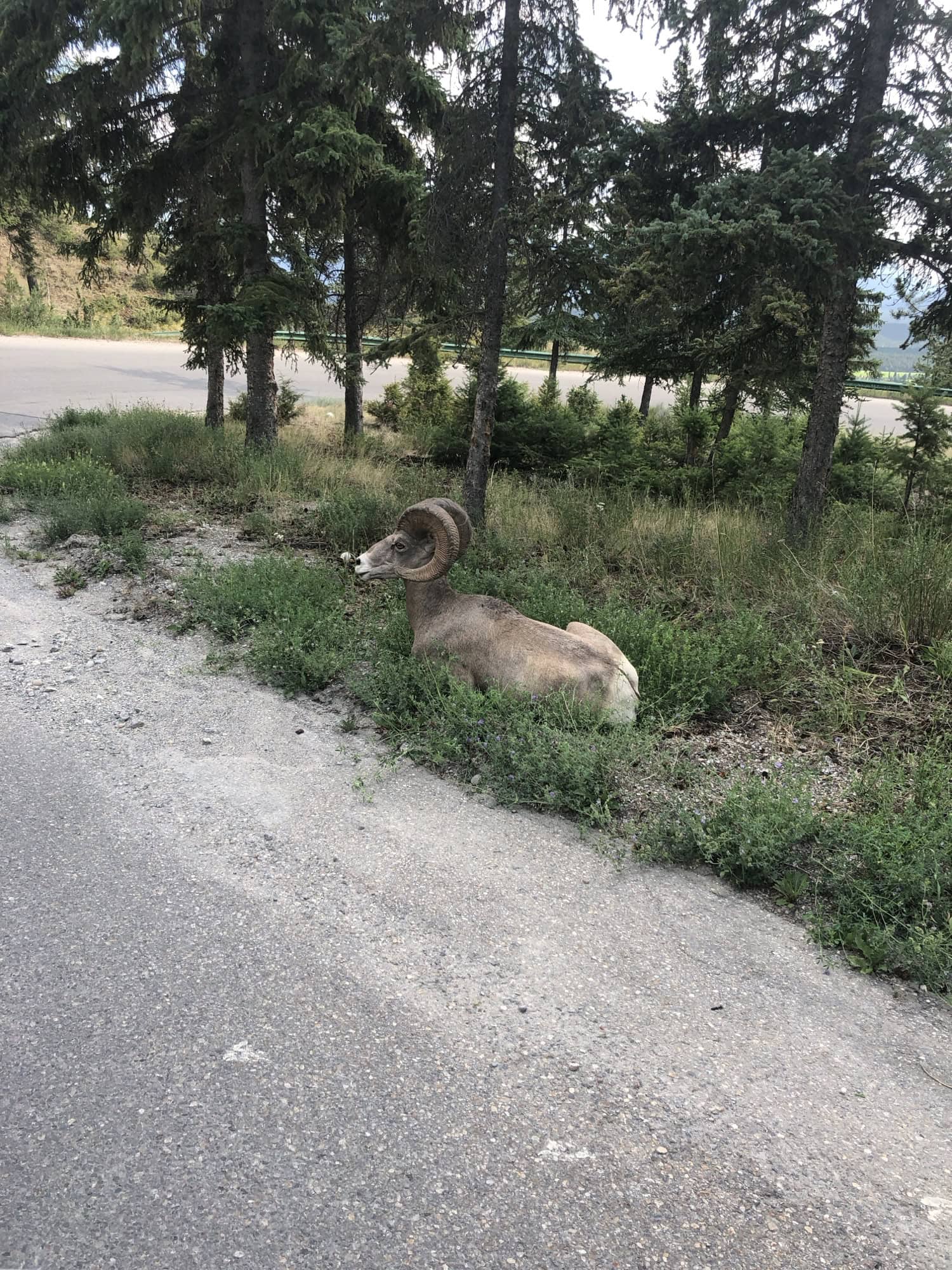
Seeing your first bighorn sheep in Alberta is strangely exciting.
One minute you are driving through Kananaskis looking at mountains. The next minute traffic slows down because six sheep have decided the middle of the road is apparently the perfect place for lunch.
Nobody told them there was a highway there.
Bighorn sheep are Alberta’s provincial animal, and they are one of the larger wild animals you have a realistic chance of seeing on a day trip from Calgary.
You still need some luck.
This is wildlife, not a zoo.
There is no viewpoint where someone releases the sheep at 10 every morning for tourists.
But there are a few areas around Calgary where your chances are considerably better than simply driving west and hoping for the best.
If seeing bighorn sheep is the goal, I would start with Sheep River Provincial Park and Kananaskis.
Sheep River Provincial Park is probably your best bet
The name gives you a pretty good clue.
Sheep River Provincial Park southwest of Calgary contains the Sheep River Wildlife Sanctuary, which was established specifically to protect Rocky Mountain bighorn sheep.
Alberta Parks says the open grasslands and relatively mild winter conditions here provide important winter habitat for the local herd. Sheep traditionally spend winter in the park before moving farther west into higher mountain country during warmer months.
That makes the Sheep River Valley one of the first places I would consider if somebody asked where to look for bighorn sheep near Calgary.
The drive is beautiful even if you see absolutely nothing.
That is important.
Never plan a wildlife trip where the entire day becomes a failure because an animal did not appear.
How do you get to Sheep River Provincial Park?
From Calgary, drive south toward Diamond Valley and continue west on Highway 546 into Kananaskis Country.
The scenery changes gradually.
You leave the city, cross ranch country and eventually follow the Sheep River toward the mountains.
It is a much quieter experience than driving Highway 1 toward Banff.
There are several day use areas along the road, including Sandy McNabb, Sheep River Falls, Bighorn Lookout and other stops farther into the valley.
Do not rush through all of them looking for sheep.
Drive slowly.
Keep your eyes on open grassy slopes.
Look around river flats.
Scan ridges and open areas rather than staring only at the pavement.
And let whoever is not driving do most of the searching.
Winter is particularly interesting around Sheep River
Bighorn sheep use Sheep River Provincial Park as winter range.
The open south facing slopes receive relatively little snow, while Chinook winds can expose grass that sheep can reach during colder months.
That makes winter an interesting time to look for them.
There is a catch.
Highway 546 closes to public vehicle traffic farther into Sheep River Provincial Park from December 1 until May 15. The closure helps protect wildlife and limits vehicle access through the winter range.
You can still access the eastern part of the Sheep River area, including Sandy McNabb.
You simply cannot drive the complete summer road deep into the valley.
Do not arrive at the winter gate and decide that closed somehow means closed for everyone except you.
The closure is there for a reason.
Sandy McNabb is worth checking
Sandy McNabb is one of the easiest Sheep River locations to access throughout the year.
There are trails, picnic facilities and open foothills terrain.
Bighorn sheep are sometimes seen in this area, especially when they move through the surrounding grasslands. Local Kananaskis hiking information notes that sheep can be spotted around the Sandy McNabb area depending on the season.
Even if the sheep refuse to cooperate, you can still go for a walk.
That is how I would approach wildlife watching here.
Bring binoculars.
Take a hike.
Keep looking around.
If sheep appear, great.
If they do not, you still spent the morning in the foothills instead of circling a parking lot waiting for an animal.
Bighorn Lookout has the right name for a reason
Farther west along the Sheep River road, Bighorn Lookout is another obvious place to stop when seasonal vehicle access is open.
The viewpoint overlooks the Sheep River canyon and surrounding grasslands.
These open slopes form part of the habitat that makes the valley important to bighorn sheep.
You do not need a major hike to reach the viewpoint.
It is more of a short stop where you can stretch your legs, look over the landscape and scan for wildlife.
Bring binoculars if you own them.
A sheep standing hundreds of metres away on a hillside is much easier to appreciate through binoculars than through maximum phone zoom.
Highway 40 in Kananaskis is another good place to look
If Sheep River is one of the best dedicated wildlife areas, Highway 40 is probably where many visitors accidentally encounter their first bighorn sheep.
Friends of Kananaskis Country identifies several places where sheep commonly appear, including Highway 40 near Barrier Lake, Galatea, Grizzly Creek and the Kananaskis Lakes turnoff. Sheep are also frequently seen around Sibbald Flats and along the Sheep and Elbow Valley roads.
In other words, you do not necessarily need to hike anywhere.
Sometimes you just need to drive through Kananaskis and pay attention.
Sheep occasionally wander onto the road itself.
That sounds charming until you remember that you are driving a vehicle weighing a couple thousand kilograms.
Slow down.
Why are bighorn sheep standing on the road?
Salt is one reason.
Bighorn sheep are attracted to minerals and may lick road surfaces and gravel where salts accumulate. Friends of Kananaskis Country notes that sheep regularly seek minerals around roads in the region.
That helps explain why you sometimes see an entire group casually occupying pavement while drivers wait.
It does not mean the sheep want to meet you.
Stay in the vehicle.
Give them room.
Eventually they usually move.
Please do not create a wildlife traffic jam
This happens constantly.
One animal appears beside a road.
The first car slows down.
The second car stops.
Somebody gets out with a phone.
Five minutes later there are fifteen vehicles, three people standing on the shoulder and an increasingly nervous animal surrounded by humans.
Do not be that person.
Friends of Kananaskis Country recommends staying in your vehicle around roadside bighorn sheep and continuing past slowly rather than creating a traffic jam.
If there is a legitimate pullout where you can get completely off the road, use it.
If there is not, keep moving.
Seeing an animal does not give you permission to park wherever gravity allows.
Barrier Lake is a useful area to watch
Barrier Lake itself is already a worthwhile stop.
You have water, mountains and several hiking options.
Bighorn sheep are also known to appear around the Highway 40 corridor near Barrier Lake.
I would not drive directly to the lake expecting sheep to be standing beside the parking lot.
Think of it as somewhere worth visiting anyway where a wildlife sighting becomes a bonus.
Walk around.
Look at the slopes.
Pay attention while driving Highway 40.
That is much more enjoyable than spending two hours parked with binoculars pointed at an empty hillside.
The Kananaskis Lakes area can be productive too
Farther south on Highway 40, sheep are sometimes seen near the Kananaskis Lakes turnoff and surrounding roads.
This area gives you plenty of other reasons to visit.
Upper Kananaskis Lake is nearby.
Peter Lougheed Provincial Park has hiking trails and picnic areas.
Highway 40 itself is one of the prettiest drives close to Calgary.
If wildlife is your main interest, go slowly and pay attention to open slopes as you travel.
Early morning can be particularly pleasant because roads are quieter and many animals are more active around dawn.
Sibbald Flats sometimes has sheep too
Sibbald is not the first place most visitors think about for bighorn sheep.
That might actually be a good thing.
Friends of Kananaskis Country identifies Sibbald Flats as another place where sheep are known to appear.
The area is accessed from Highway 68 and feels much quieter than the main Highway 40 corridor.
There are picnic areas, trails and foothills scenery, so again, the trip still works if you see no wildlife.
I would choose Sibbald when I wanted a relaxed local day and wildlife watching was part of it rather than the only objective.
Are there bighorn sheep around Canmore?
Yes.
Bighorn sheep occur throughout the Bow Valley and Kananaskis region.
They can occasionally be seen around roads and rocky slopes near Canmore.
That does not mean driving through residential streets looking for wildlife is a particularly good plan.
If you happen to encounter sheep, enjoy them from a respectful distance.
Do not walk closer because you want a photograph with a bigger sheep and a smaller mountain behind it.
Zoom lenses were invented for a reason.
When is the best time of day?
Early morning and evening are generally good times for wildlife watching.
Many mammals become more active when temperatures are cooler and human activity is lower.
Local Kananaskis wildlife guidance notes that dawn and dusk can improve the chances of spotting animals such as moose, deer and elk. Bighorn sheep may also be active near roads and mineral sources during the day.
I would not obsess over finding the perfect minute.
A slow morning drive through good habitat is more useful than arriving at exactly 6:43 because somebody online claimed that was sheep o’clock.
Wildlife does not use Google Calendar.
What is the best season?
There is no single season when bighorn sheep suddenly become guaranteed.
You can encounter them throughout the year.
Winter can be particularly interesting around Sheep River because the area provides important winter habitat.
Spring and summer bring different movement patterns as sheep travel toward higher terrain.
Fall can also be an interesting time because animals become more active around the breeding season.
Road access matters just as much as wildlife behaviour.
Several Kananaskis roads have seasonal closures, so always check current access before building a trip around one specific location.
Can you see the big rams?
Possibly.
Adult male bighorn sheep are the ones with the enormous curled horns that everybody hopes to photograph.
Females also have horns, but theirs are much smaller.
The largest rams are spectacular animals.
They are also not props.
Do not try to position yourself beside one for a selfie.
Do not walk between animals.
Do not follow a ram because it moved away from you.
If the animal changes its behaviour because of your presence, you are already too involved in its day.
How close should you get?
Not close.
That is the easiest rule.
Alberta wildlife guidance recommends observing animals from a safe distance and using binoculars or a zoom lens rather than approaching.
Bighorn sheep can appear extremely calm around people.
That does not make them domesticated.
A large ram is strong, fast and carrying two enormous horns attached to its head.
You do not need to discover how patient it is.
Give wildlife the space to decide where it wants to go.
Never feed bighorn sheep
This should be obvious.
Unfortunately, apparently it still needs to be said.
Do not feed sheep.
Do not put food on the ground to bring them closer.
Do not toss snacks from the car.
Do not leave food behind.
Wild animals that become comfortable around people and vehicles can end up in dangerous situations.
Feeding wildlife also changes natural behaviour and encourages animals to spend more time around roads and developed areas.
That cute photograph is not worth it.
Be extra careful when sheep are on the highway
Bighorn sheep sometimes behave as if road rules were invented for a different species.
They may stand on pavement.
They may cross slowly.
They may step onto the road without warning.
Friends of Kananaskis Country specifically advises drivers to slow down and avoid forcing their way through groups of sheep.
Expect another vehicle around the corner too.
Sometimes the bigger danger is not the animal.
It is the driver ahead who suddenly slams on the brakes because they saw one.
Leave space.
Can you see other wildlife on the same trip?
Definitely.
Kananaskis is home to elk, mule deer, white tailed deer, moose, coyotes, black bears, grizzly bears, wolves, cougars and many smaller mammals.
You are much more likely to see some of those than others.
Deer are common.
Elk are reasonably possible.
Moose require more luck.
Bears are something you may see, but I would never design a drive around trying to find one.
Large carnivore sightings are relatively uncommon, which is probably best for everybody involved.
If you encounter a bear, stay inside the vehicle and give it plenty of room.
Never create a bear jam.
What about moose?
People ask this constantly too.
Moose live throughout Kananaskis and the foothills.
Wetlands, willow areas and forest edges are places worth watching.
Early morning and evening generally give you better odds.
But moose sightings are unpredictable.
I would never promise visitors that driving one specific road will produce one.
Also, do not underestimate them.
Moose look slow because they often stand around eating.
They are extremely large animals that can move surprisingly fast.
Give them space.
Do you need a Kananaskis Conservation Pass?
If you park your vehicle at provincial park or public land sites within the Kananaskis Conservation Pass area, yes.
The current rate is $15 for a day pass or $90 for an annual pass for a personal vehicle. One daily pass covers the vehicle, not each passenger.
If you only drive through without stopping, you do not need the pass.
For a wildlife watching day, though, you will probably want to stop somewhere.
Buy the pass before leaving home.
Cell service is unreliable along several roads mentioned in this article, including Highway 546 in Sheep River, Highway 68 through Sibbald and portions of Highway 40.
Bring binoculars
This is probably the single best piece of equipment for a wildlife day.
Your phone is not binoculars.
Neither is walking closer.
A basic pair of binoculars completely changes how much you notice.
Suddenly that brown dot halfway up a slope becomes a sheep.
The strange shape beside the trees becomes an elk.
You also spend more time actually watching animals instead of immediately trying to photograph them.
That is not a bad thing.
A camera with a zoom lens helps
If photography matters to you, bring the longest lens you own.
Wildlife photography rewards distance.
A good photograph taken from far away is much better than a phone photograph taken after disturbing an animal.
Use the vehicle as cover when appropriate.
Keep movements calm.
Do not whistle, clap or make noises trying to get an animal to look at the camera.
The sheep does not care about your Instagram engagement.
My favourite wildlife drive from Calgary
If I had visitors who wanted to see wildlife but did not want to spend all day driving, I would probably head toward Sheep River.
I would leave Calgary in the morning.
Drive through Diamond Valley.
Continue west toward Sandy McNabb.
Then, when the seasonal road is open, I would keep going into Sheep River Provincial Park.
Stop at viewpoints.
Walk a little.
Scan open slopes.
Have lunch somewhere beside the river.
If we saw bighorn sheep, fantastic.
If we saw deer, elk or something else, also fantastic.
If we saw nothing larger than a squirrel, we still had a beautiful day.
That last part is important.
Wildlife watching becomes miserable when you treat animals like attractions that failed to open on schedule.
If Sheep River is closed, try Highway 40
During the winter road closure west of Sandy McNabb, Highway 40 becomes the easier alternative.
Drive into Kananaskis from Highway 1.
Check the Barrier Lake area.
Continue south past the Galatea and Grizzly Creek sections.
Watch around the Kananaskis Lakes turnoff.
Take your time.
Stop only in proper parking areas.
There are plenty of lakes, viewpoints and walks to fill the day even if the sheep are somewhere else.
The best wildlife encounters usually happen by accident
That is the funny part.
You can spend an entire morning intentionally looking for bighorn sheep and see nothing.
Then two weeks later you are driving to a hike and find fifteen of them standing beside the road.
That unpredictability is what makes seeing wildlife exciting in the first place.
If bighorn sheep were guaranteed at one parking lot every afternoon, the experience would start feeling very different.
Go somewhere beautiful.
Keep your eyes open.
Bring binoculars.
Drive slowly.
And when you finally see a huge ram standing beside the road, enjoy the moment without immediately walking toward it.
The best wildlife encounter is usually the one where the animal gets to continue its day exactly as if you were never there.
Did you know that your internet service provider can track your online activity? Want to hide your identity online and keep your browsing habits private? Try NordVPN!
*This post might contain affiliate links. If you click on a link, I might receive a small commission.
