
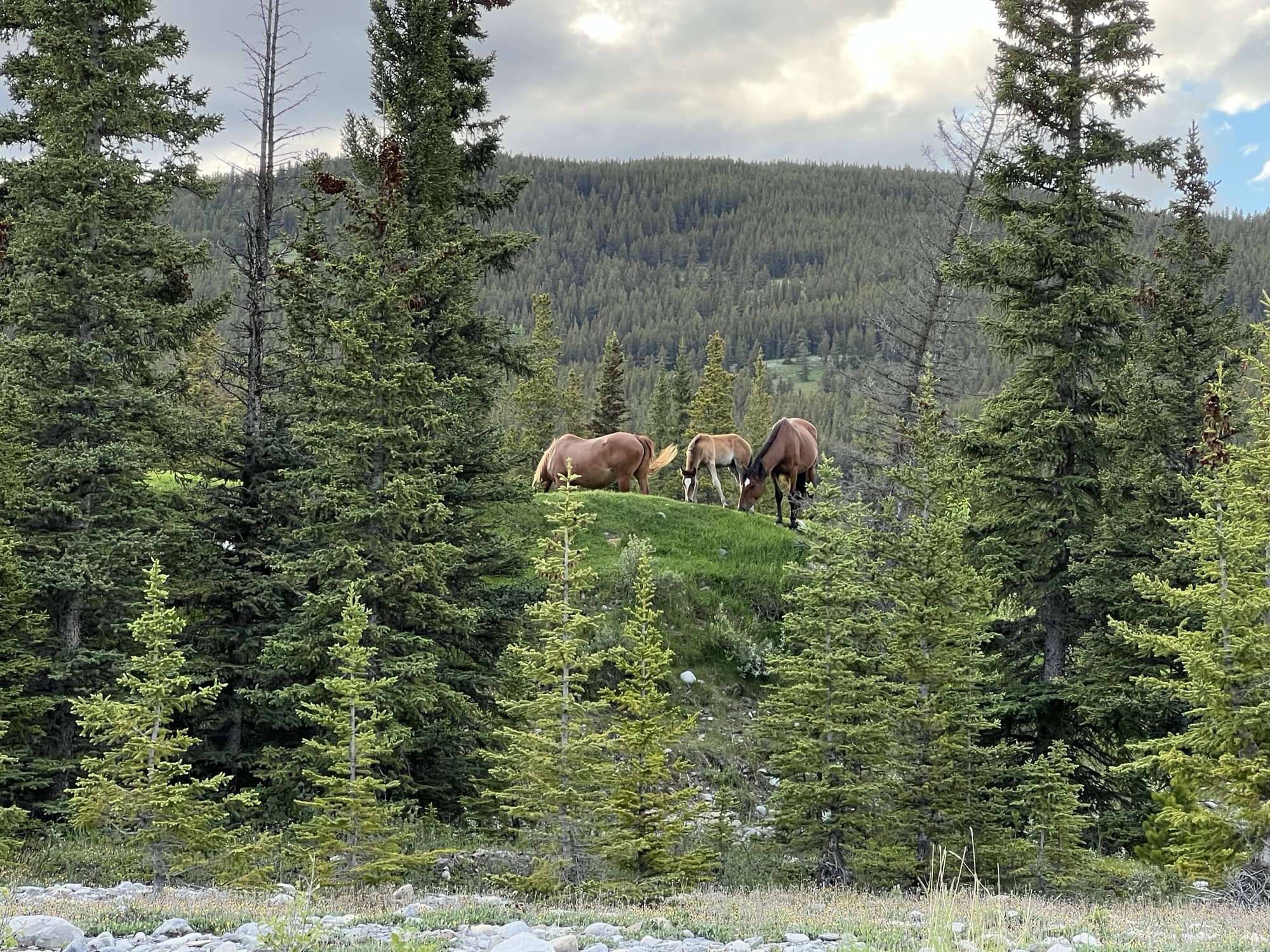
There are days in Alberta when you drive into the foothills hoping to see wildlife and come home with photographs of exactly three squirrels.
Then there are days when you turn a corner west of Sundre and an entire group of horses is standing in a meadow.
No fence.
No barn.
No owner walking toward them with a bucket.
Just horses living out in the foothills.
Alberta has a surprisingly large population of free roaming horses, and some of the best places to look for them are within a reasonable drive of Calgary.
If seeing wild horses is the goal, I would head toward Sundre.
Not Banff.
Not Kananaskis.
Sundre.
The country west of town toward the Red Deer River and Ya Ha Tinda supports some of the largest concentrations of free roaming horses in Alberta. Sundre Tourism specifically recommends the road west toward Ya Ha Tinda as one of the best routes for visitors hoping to see them.
There is no guarantee.
That is important.
You are not driving to a wildlife attraction where horses are released into a field every morning at 10.
You might see twenty.
You might see two.
You might see none.
But even on a horse free day, the drive through the foothills is good enough that the trip does not feel wasted.
Are there really wild horses in Alberta?
Yes.
The Alberta government officially tracks free roaming horse populations along the eastern slopes of the Rocky Mountains.
Government surveys divide the population into six management areas called Brazeau, Nordegg, Clearwater, Sundre, Ghost River and Elbow.
During the 2026 survey, 2,072 horses were counted across those six areas.
That was a significant jump from the minimum count of 1,485 in 2025. The government notes that these are minimum counts, meaning there may be additional horses that were not observed during aerial surveys.
The Sundre and Ghost River areas have the largest populations and are important enough that Alberta uses additional survey methods there to estimate population density.
So no, the horses are not a local myth created to sell postcards.
There are a lot of them out there.
Finding them from the road is the harder part.
Are they actually wild?
This question can start a surprisingly intense argument.
You will hear people call them wild horses.
You will also hear them called feral horses.
The Alberta government officially uses the term feral horse because the animals descend from domestic horses that escaped, were released, or otherwise established free roaming populations.
The Wild Horses of Alberta Society generally refers to them as wild horses.
For somebody standing beside a gravel road watching a band of horses disappear into the forest, the terminology probably matters less than it does in a government document.
They live freely on the landscape, form social groups, reproduce without ordinary domestic management and survive Alberta winters on their own.
They are also legally managed differently from native wildlife. Alberta regulates them under its feral horse management framework and related legislation.
I am going to call them wild horses here because that is how most people searching for them around Calgary describe them.
Sundre is the place I would start
Sundre sits northwest of Calgary where prairie gradually turns into foothills.
From Calgary, the drive takes roughly an hour and a half depending on where you start and which route you use.
You can reach Sundre quickly using the major highways through Olds.
Or you can make the drive more scenic by heading through Cochrane and following Highway 22 north.
If I had the entire day, I would choose the scenic route.
The landscape west and northwest of Calgary slowly changes from developed countryside into ranch country and foothills.
By the time you reach Sundre, the Rockies are sitting on the western horizon and the whole trip already feels much farther from Calgary than it really is.
Get fuel in Sundre.
Get food.
Use a proper washroom.
Download your maps.
Then head west.
That last part is important.
Cell service becomes weak or disappears completely as you travel deeper into the foothills. Sundre Tourism specifically warns that the road toward the wild horse country is mostly gravel and has little to no cell service.
Drive west toward Ya Ha Tinda
This is the route most people are looking for.
From Sundre, continue west toward the Red Deer River and eventually toward Ya Ha Tinda.
Sundre Tourism describes this corridor as the best local route for finding wild horses and says most of Alberta’s free roaming horses can be found in the country west of town.
Do not expect one magical field filled with horses.
You are driving through a large landscape.
Look at open meadows.
Look along forest edges.
Watch cutblocks and grassy clearings.
Scan hillsides.
Horses prefer areas where they can find forage, and the Alberta government notes that free roaming horses commonly use grassy meadows, shrubland and younger cutblocks.
Sometimes they are close to the road.
Sometimes they are far away.
Sometimes they are behind trees and you do not notice them until someone in the passenger seat yells, “Horses!”
This is a much better job for the passenger than the driver.
The driver should concentrate on the road.
The gravel road is part of the adventure
The route west of Sundre is not a polished national park highway.
Much of it is gravel.
Conditions vary.
One week it may feel perfectly comfortable in a normal car.
After heavy weather, sections can become rougher, dustier or muddier.
Drive according to conditions.
Do not treat the road like a rally stage because you saw a pickup truck disappear around a corner at twice your speed.
That driver may know every pothole.
You probably do not.
You should also start with enough fuel.
Once you leave Sundre and head farther west, services become limited.
This is exactly the kind of trip where having half a tank suddenly feels much less clever once your phone loses service.
Do you need a four wheel drive vehicle?
In normal dry conditions, you do not necessarily need a serious off road vehicle just to explore the main route west of Sundre.
Plenty of ordinary vehicles travel gravel roads.
But conditions matter much more than the logo on the front of your car.
Heavy rain can change a road quickly.
Snow can arrive surprisingly early or late in the foothills.
Some side roads are far rougher than the main route.
If you do not know where a road goes, do not assume that seeing tire tracks means your vehicle belongs there.
Stay on roads appropriate for your car and your experience.
There is enough to see without turning a wild horse trip into a recovery tow.
When are you most likely to see the horses?
There is no guaranteed time.
Wild horses move.
Weather changes where they feed and rest.
Human activity changes their behaviour too.
If I had a choice, I would go earlier in the morning or later in the afternoon.
The light is better for photography, the roads tend to be quieter and wildlife in general is often easier to spot when the day is cooler.
That does not mean the horses disappear at noon.
People see them at all kinds of times.
The bigger advantage of leaving early is simply giving yourself more time.
You can drive slowly.
Stop for lunch.
Explore farther west.
Turn around when you feel like it.
There is no pressure to find horses before sunset.
Spring is a great time to look
Spring can be particularly interesting because the foothills begin opening while the mountains still hold snow.
Young foals also begin appearing as the season progresses.
That combination can make for incredible photographs.
The roads, however, may be messy.
Spring in Alberta often involves mud, lingering snow and weather that cannot decide whether it is April or January.
Check conditions before leaving Calgary.
A beautiful sunny forecast in the city does not tell you what a gravel road near the mountains looked like after yesterday’s storm.
Summer is easier
For a first trip, summer is probably the simplest season.
Roads are generally easier.
Daylight lasts forever.
You can combine wild horse searching with a picnic, hike or longer scenic drive.
The downside is traffic and dust.
More people are exploring the foothills.
Logging vehicles, campers and recreational traffic can all share these roads.
Give larger vehicles room.
And when somebody passes you, let the dust settle before trying to see anything through it.
Fall might be my favourite
The foothills look fantastic in September and October.
Aspen and shrubs begin changing colour.
Morning temperatures become cooler.
The light gets softer.
You may have fresh snow appearing on distant peaks while the lower valleys are still in autumn colours.
For photography, that is hard to beat.
The only problem is that Alberta fall can turn into Alberta winter very quickly.
A road that was dry on Saturday can look completely different after an overnight storm.
Can you see wild horses in winter?
Yes.
The horses live out there year round.
Winter can make them easier to notice against snow and open hillsides.
It also makes the trip much more serious.
Short daylight, snow covered gravel roads, extreme cold and unreliable cell service are a different combination from a summer afternoon drive.
If you are unfamiliar with remote winter driving, this is not the trip where I would learn.
Go when conditions are good.
Carry proper winter gear.
Keep plenty of fuel in the vehicle.
And make sure somebody knows where you went.
Seeing horses is not worth getting stuck on a remote road after dark.
How close can you get?
Not close.
This is where people sometimes forget the entire reason the experience is special.
These horses are living freely.
Do not walk toward them trying to get a better photograph.
Do not surround them with vehicles.
Do not try to touch one.
Do not bring children close because the horses look calm.
A horse can weigh hundreds of kilograms and move much faster than you can.
A stallion protecting a group does not care that your phone camera has terrible zoom.
Watch from a distance.
Use binoculars.
Use a zoom lens.
Let the horses decide whether they remain visible or move away.
If they move because of you, you were already too close.
Please do not feed them
No carrots.
No apples.
No handful of grass from beside the road.
No snacks through the car window.
Nothing.
Feeding free roaming horses encourages them to approach people and roads.
That is bad for the horses.
It also creates dangerous situations for drivers.
The entire point is to see animals behaving naturally.
A horse walking toward every parked vehicle looking for food is not that.
Do not follow a herd
This one should be obvious, but excitement does strange things to people.
If a group crosses the road and disappears into the trees, let them disappear.
Do not walk into the forest after them.
Do not drive down random side roads hoping to intercept them.
Do not use a drone to chase them from above.
You already had the encounter.
Enjoy it.
There will always be someone online with a closer photograph.
That does not mean you need one.
Bring binoculars
For this particular trip, binoculars are more useful than almost anything else you can pack.
Horses may be standing far across a meadow.
Without binoculars, you see brown shapes.
With binoculars, you can watch the entire group.
You start noticing foals.
You see which horse appears to be leading.
You notice social behaviour that is completely invisible when everyone is just trying to get close enough for a phone photo.
A basic pair is fine.
This is not astronomy.
A proper camera helps too
Wild horse country is made for a zoom lens.
You have horses, foothills, forests and mountains all in one landscape.
The temptation is to fill the entire photograph with the animal.
Try wider photographs too.
A horse standing beneath the eastern slopes says much more about Alberta than another close portrait of a horse’s face.
The landscape is part of the story.
That is why you drove out here in the first place.
There are more wild horses in Alberta than you might think
The 2026 provincial minimum count recorded 2,072 horses across Alberta’s six management zones.
Of those, 1,788 were classified as adults, 281 as younger horses and only three as foals because the surveys took place between January and March, before most foaling occurs.
The survey number is especially interesting because it is the highest minimum count listed by the province since its modern annual series began in 2013.
Again, that does not mean you will see hundreds from the road.
The horses are spread across enormous areas of foothills.
But knowing there are more than two thousand out there explains why sightings around Sundre are not unusual.
Why are so many around Sundre?
The Sundre area contains the combination horses need.
Open forage.
Forested shelter.
Water.
Large areas of public land.
The Alberta government describes grassy meadows, shrublands and younger forest cutblocks as preferred habitat.
The Sundre management zone also extends west toward Banff National Park and supports numerous bands of horses.
It is simply excellent horse country.
Drive through it slowly and that becomes obvious even before you see an animal.
Huge grassy clearings sit between forested foothills.
The mountains rise behind them.
You start looking at every brown shape differently.
Tree stump?
Cow?
Horse?
Eventually one of them moves.
What is Ya Ha Tinda?
If you keep travelling west, Ya Ha Tinda makes a natural destination for the drive.
The name comes from the Stoney Nakoda language and is commonly translated as Prairie in the Mountains.
It is a spectacular area near the eastern edge of Banff National Park, surrounded by foothills and mountain scenery.
The journey there follows the same general country where wild horses are often spotted.
That gives you a destination even if the horses decide not to appear.
I always like wildlife trips that work this way.
You are going somewhere worth seeing anyway.
The animal sighting becomes a bonus rather than the entire reason the day succeeds or fails.
Stop in Sundre on the way back
Sundre works well as more than a fuel stop.
After several hours on gravel roads, a restaurant and proper coffee begin looking unusually exciting.
Walk around town.
Eat.
Refuel.
Then head back toward Calgary.
This also breaks up the drive and keeps the day from becoming six straight hours inside the car.
If you have enough time, you can easily turn the trip into an overnight visit and explore more of the foothills the following morning.
There is an easier way if you really want to see horses
If your main goal is seeing wild horses rather than searching for them, there is another option.
The Wild Horses of Alberta Society operates a facility west of Sundre where rescued wild horses are cared for, rehabilitated and, when possible, prepared for adoption.
The organization currently offers scheduled tours of the facility. Their website lists visit times and asks visitors to contact them to arrange a tour.
This is obviously a different experience from unexpectedly spotting a free roaming herd beside a foothills road.
But it gives you the opportunity to learn about the horses, their behaviour and the issues surrounding their management in Alberta.
It is also far more reliable than hoping a wild band happens to be visible during your drive.
The facility is not a petting zoo
The Wild Horses of Alberta Society exists to protect and care for horses, not to provide a roadside attraction.
Some horses at the facility have been rescued after injury or after leaving public land for private property.
The organization says keeping horses wild and free is its first goal, with intervention used when animals are in distress or cannot safely remain where they are.
If you visit, go because you want to learn.
Not because you expect every horse to pose beside you.
Are wild horses dangerous?
Any horse can be dangerous if you behave badly around it.
These animals are not accustomed to ordinary handling the way a domestic trail horse might be.
Do not interpret a horse standing quietly as an invitation to approach.
Wild horses have social structures.
Stallions may defend their groups.
Mares may have foals nearby.
Any horse can kick or bite when frightened or threatened.
Distance solves most of these problems.
Stay back and you get to watch them behave naturally.
That is better for everyone.
What else can you see on the drive?
The foothills west of Sundre are wildlife country.
You may see deer.
Elk are possible.
Moose live in the region.
Black bears and grizzly bears also use the eastern slopes.
That is another reason not to wander into the forest blindly after horses.
If you stop for a walk or picnic, treat the area as bear country.
Carry bear spray where appropriate.
Keep food controlled.
Pay attention to your surroundings.
A wild horse trip can become a wildlife trip very quickly.
Do you need a Kananaskis Conservation Pass?
Not for the Sundre wild horse route simply because you are driving west of Sundre.
The Kananaskis Conservation Pass applies to designated Kananaskis areas farther south.
This trip is in a different part of Alberta’s eastern slopes.
Other recreation fees or rules can still apply depending on where you stop or camp, so check the specific site if you plan to do more than drive and sightsee.
Do you need cell service?
You might want it.
You should not expect it.
Sundre Tourism specifically warns that there is little to no cell coverage along the route west toward Ya Ha Tinda.
Download offline maps before leaving Sundre.
Save the route.
Tell someone where you are going if you plan to travel far into the backcountry.
Bring water.
Keep a warm layer in the vehicle.
Carry a basic emergency kit.
None of this is dramatic wilderness survival preparation.
It is just sensible Alberta road trip preparation.
What if you see no horses?
Keep driving for the scenery.
Have lunch somewhere beautiful.
Go to Ya Ha Tinda.
Stop beside the Red Deer River.
Take photographs of the foothills.
Then try again another day.
This is the part of wildlife watching that social media tends to edit out.
You see the photograph of twelve horses running through a meadow.
You do not see the three previous trips when the photographer drove around for four hours and saw nothing.
That is normal.
Wildlife encounters feel special precisely because they are not guaranteed.
My plan for a wild horse day from Calgary
I would leave Calgary early enough to reach Sundre in the morning.
Fill up the car.
Grab coffee and food.
Download the route.
Then drive west slowly.
I would stop at viewpoints and legal pullouts instead of rushing toward one supposed secret location.
Keep binoculars within reach.
Watch open meadows and forest edges.
Continue toward Ya Ha Tinda if road and weather conditions are good.
Have lunch somewhere along the way.
Then take the same approach on the return trip.
The horses may be somewhere completely different by afternoon.
If I really wanted a guaranteed horse experience, I would arrange a visit with the Wild Horses of Alberta Society and combine it with the drive.
That gives you both sides of the story.
You learn about the horses that need human help and then head into the foothills where others are still living on their own.
The best part is seeing them where they belong
A horse in a pasture is nice.
A horse walking through a foothills meadow with the Rocky Mountains behind it feels completely different.
That is why people keep driving west of Sundre looking for them.
You never know exactly where they will be.
You cannot reserve a sighting.
You cannot make them walk closer.
You simply drive through the landscape and hope your timing is good.
And when it is, pull over somewhere safe, stay back and watch for a while.
You might have driven from Calgary hoping to take a photograph.
There is a good chance you will end up forgetting about the camera for a few minutes.
That is usually a sign that the trip was worth it.
Did you know that your internet service provider can track your online activity? Want to hide your identity online and keep your browsing habits private? Try NordVPN!
*This post might contain affiliate links. If you click on a link, I might receive a small commission.
